


- Home
- Companies
- BlueSky Global LLC
- Products
- BlueSky - Asbestos Abatement Dust ...
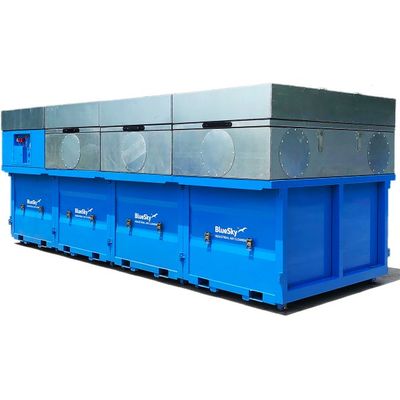
BlueSky - Asbestos Abatement Dust Collector
BlueSky Air Cleaners are self-contained dual-stage dust collectors ideally suited for asbestos abatement activities. A BlueSky® dust collector, which effectively functions as pressure differential unit, is capable of withdrawing large volumes of contaminated air from a contained workspace, thereby fully meeting the requirements of a pressure differential containment system. Typically, such an area is maintained at a continuous negative-pressure to eliminate the risk of the contaminant leaking into the surroundings and the work can, therefore, take place WITHOUT cross-contamination.
The methodology of the pressure differential containment system is to seal the majority of air-leakage paths so that the negative pressure is easily maintained. Typically, for any containment work area, a MINIMUM of five (5) air changes per hour is recommended to reduce the concentration of dangerous fine fibers and particulates, and effectively improve the air quality and potential contamination (settling of fibers) in a work area.
A BlueSky® dust collector configured for hazardous waste is equipped with first stage primary filters (Merv 16), and second stage HEPA filters (H13). In such a dual stage configuration, 99.97% of airborne asbestos fibers are filtered and retained within the collector. Further, in the unlikely event of a seal or filter failure, the use of primary AND secondary filters (both under negative pressure) prevents the uncontrolled asbestos fiber release.
A unit should typically be located away from the air entry routes to establish the longest possible airflow path. Air-moving auxiliary fans may be placed within containment workspaces to further circulate air and direct contaminated air out of stagnant zones.
To determine the number of BlueSky® dust collectors required, the containment volume (in cubic feet) is calculated by multiplying floor area by ceiling height. The total ventilation requirement for the containment, in cubic feet per minute (CFM), is then determined by dividing the volume by twelve (12).
Since each BlueSky® dust collector is capable of 20,000 CFM, the number of BlueSky® pressure differential units needed will then be determined by dividing the ventilation requirement (CFM) by 20,000.
Ideally, there should be at least one additional unit on site as a backup in case of a unit service requirement.
When the final inspection and results of the final air tests have indicated the work area has been completely decontaminated, the pressure differential units may be safely turned off and removed/relocated.
SmartBoxTM inlet-covers should be reinstalled once ducting is removed to ensure effective sealing of BlueSky® dust collector inlets.
BlueSky® dust collectors incorporate a unique patented system called SmartBoxTM technology. A SmartBoxTM module effectively ensures that the collected hazardous asbestos fibers do not pose a new threat to service personnel. The SmartBoxTM module is the dirty part of the dust collector. It contains the asbestos dust and contaminated filters. It`s removed and discarded as hazardous waste.
SmartBoxTM modules may be transported in open trucks. They should be labeled by the abatement contractor with the same warning as the solid waste disposal bags. A SmartBoxTM must be treated and disposed of in accordance with the appropriate asbestos waste disposal guidelines.
Since a correctly sealed SmartBoxTM module is a steel enclosure, the transportation vehicles will NOT need to be specially decontaminated, and the clothing worn by the servicing crew will not need to be included in the disposal process.