

- Home
- Companies
- Sound Planning Limited
- Products
- Sound Planning - Attenuators
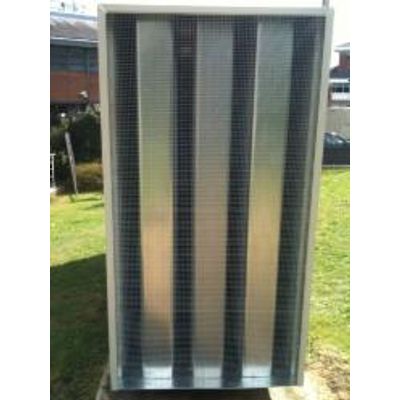
Sound Planning - Attenuators
A comprehensive range of attenuators has been developed to cater to the diverse constructional and performance specifications required in the mechanical services industry.
Circular Silencer
The circular silencer range is typically used in ductwork systems, where it can be duct mounted or bolted directly onto the fan – if size allows. Depending on the acoustic requirements, circular attenuators can incorporate a central ‘pod’ that can increase the acoustic performance in terms of insertion loss – attenuators without a pod can only offer acoustic performance at minimal resistance to airflow.
Cross-Talk
Cross-talk attenuators are selected using our calculation software – to help determine the necessary insertion losses, whilst maintaining low system pressure drops (a pre-requisite at this point in the system). This range can either be of rectangular or circular construction.
Attenuator End Connections:
- Rolled steel angle flanges (rectangular)
- Slide on Doby type flanges (rectangular)
- Spigot ends (both)
- End flanges that incorporate threaded inserts (circular)
Splitter Orientation:
- Vertically mounted splitters (rectangular)
- Horizontally mounted splitters (rectangular)
- Central pod kit (circular)
Pressure Ratings:
- DW144 class B leakage and up to 1000 Pascal’s positive pressure or 750 Pascal’s negative pressure
- DW144 class D leakage and up to 2500 Pascal’s positive pressure or 750 Pascal’s negative pressure
Other:
- Acoustic media wrapped in melinex – typically used in systems where grease and/or high moisture levels occur and hospital/clean room applications
- Wrapping of the attenuator ends with polythene to prevent the ingress of rubble on site
Attenuators with Special Requirements:
- Paint finishes
- Stainless steel construction
- Heavy gauge steel construction
- Welded construction
- Special flange requirements
- Plastic construction
- Plenum sections
Our Team
For this technology to be used by consulting engineers and contractors, a noise control engineer should attend your offices and go through the project requirements. Based on the information obtained, our team of experts will initially discuss the findings through a comprehensive and detailed report – which includes the right attenuator selections for your requests.