


- Home
- Companies
- edevis GmbH
- Products
- edevis - Automated Adhesive Seam ...
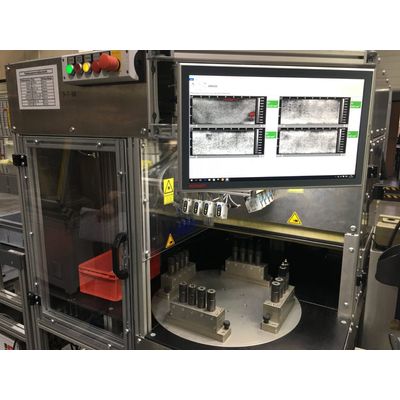
edevis - Automated Adhesive Seam Inspection System with Lockin Thermography
This automated inspection system uses lockin thermography for inline testing, focusing on detecting and evaluating the quality of adhesive bonds, particularly in fiber composite structures. The technique helps ensure the structural integrity by analyzing the heat flow on object surfaces using halogen lamps. The heat flow is captured by infrared cameras, allowing for identification of thermal signatures caused by defects or variations in material thickness. The lockin thermography method boasts high sensitivity due to its sinusoidal modulation of lamp intensity and Fourier transformation analysis of the resulting phase and amplitude images. This system is versatile, applicable to a stationary or continuous motion process, and is also available as a laboratory system. It's particularly effective in detecting delaminations, dry spots, resin accumulations, and coating issues, making it essential for maintaining the reliability and performance of complex adhesive bonds.
Inline testing with optically excited lockin thermography
It may be necessary to test adhesive bonds for strength or heat transfer. Active thermography helps to test even complex adhesive bonds and to determine the adhesive distribution, for example.
In the case of fiber composite structures, it is all about the integrity of the laminate, i.e. detecting the layer structure, avoiding delamination within the laminate, detecting dry spots or resin accumulations, testing coatings and much more…
A test takes between a few seconds and several minutes, depending on the material and thickness. Ideally, the test takes place stationary, but can also be carried out in continuous motion if necessary.
Principle of optically excited lockin thermography
The optical lockin thermography (OLT) method is based on heat flow analysis.
The surface of the object under investigation is heated with halogen lamps. The resulting heat flow into the material is altered by thermal obstacles such as impacts, delaminations or material thickness variations of the object. As a result, thermal signatures form on the surface, which are captured by an infrared camera. The sensitivity of the method is very high due to the use of the lockin technique. The intensity of the halogen lamps is modulated sinusoidally and the surface temperature is recorded at the same time. A phase and amplitude image is calculated from the measured image sequence by means of a Fourier transformation. In the phase image, interference effects resulting from different emission coefficients or inhomogeneous excitation are significantly reduced. The statement about the interface state and/or the material or coating thickness is now possible.