


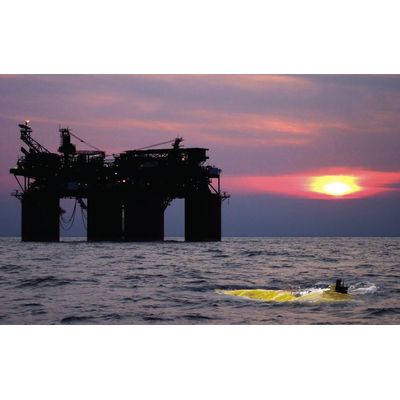
ECA - Autonomous Underwater Vehicle for Platform Surveillance
Underwater infrastructures, offshore equipment, pipelines, communication cables…can be threatened by terrorist attacks. ECA Group`s Autonomous Underwater Vehicles, A9, A18 or A3000 AUV products, offer advanced capabilities such as high resolution imagery, endurance and accurate navigation enabling to perform periodically seabed inspections to automatically detect and locate suspicious objects (mines, EOD...) from shallow to deep water, 3000 m depth.
Cybersecurity are measures or adopt of technologies, processes and practices aim to protect computers, networks and digital data from attack.
ContextUnmanned wireless systems are growing in terms of time/space autonomy: long range, long duration. Depending on use cases, operations may be done under a wide range of supervision levels: from tight monitoring (remotely operated drones) to extremely low information exchange (autonomous drones), thanks to confidence in embedded autonomous behaviors. Lloyds has recently released a classification scale for autonomy levels:
CA Group systems are mainly classified in categories AL3, AL4 and AL5. AL6 is not reached yet because of the necessary redundancy on most of equipment.
Performance in autonomy mainly comes from massive use of advanced IT technology as core of the drones. Unfortunately an obvious drawback is that unmanned wireless systems are highly exposed to risks related to the IT subsystems. Cybersecurity is no more an option for drones industry.
Cybersecurity assessmentIt is usually considered that cyber threats include:
- Availability: capability to provide the expected service
- Confidentiality: capability to protect data against access from unauthorized personnel
- Integrity: capability to guarantee IT materials (hardware, software, data) origin
In unmanned systems, cyber threats mainly concerns the following segments or functions:
- Mission execution
- Data storage
- Advanced algorithms Intellectual Property (IP)