


- Home
- Companies
- Galaxy Diagnostics, Inc.
- Products
- Galaxy - Bartonella Digital ePCR ...
Galaxy - Bartonella Digital ePCR Technologies
The most sensitive test method available for confirmation of Bartonella species infections. Bartonella Digital ePCR™ combines two sample enrichment technologies that are necessary for minimizing the risk of false negative results.
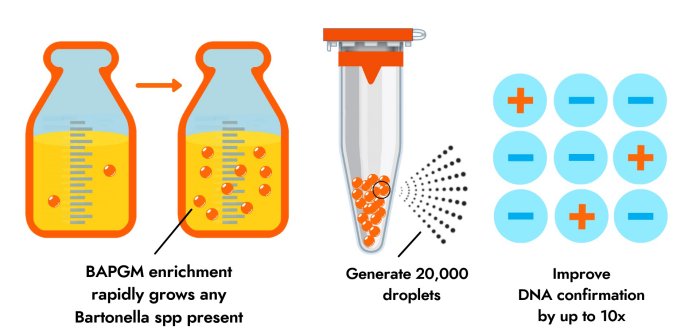
Patented BAPGM™ enrichment.
Bartonella species are often able to evade detection by even the most sensitive test methods due to the low abundance of organisms present in the sample. We overcome this testing limitation by enriching samples for one week in a patented liquid growth medium called BAPGM™. This increases the bacterial load in patient samples up to detectable levels for PCR testing.
Approximately 20,000 PCR reactions performed on each test sample.
Standard qPCR or conventional PCR techniques often miss DNA for low abundance pathogens due to inhibitory factors, like host DNA, that are also present (like searching for a needle in a haystack). Instead of performing a single PCR reaction on the test sample (aliquot), ddPCR technology partitions the aliquot into ~20,000 droplets and performs a PCR reaction on each droplet. This powerful technology decreases inhibition and increases the sensitivity of PCR detection by as much as 10 times reducing false negative results.
Detects a broad range of Bartonella species.
This test panel includes ddPCR on both blood and BAPGM™ enriched samples using genus level primers that are designed to pick up a broad range of Bartonella species. Over 20 species of Bartonella have now been documented in human and animal diseases. This approach ensures that positive cases of infection with less common Bartonella species are not missed.
Identifies positive cases missed by IFA serology.
Prior research using BAPGM™ enrichment and PCR confirmation consistently shows that direct detection will often confirm active infection in patients with negative Bartonella IFA serology results. We recommend baseline testing that combines both direct and indirect detection methods for confirmation of Bartonella species infection.