


- Home
- Companies
- BAT Geosystems AB
- Products
- BAT - Model GMS - Permeameter
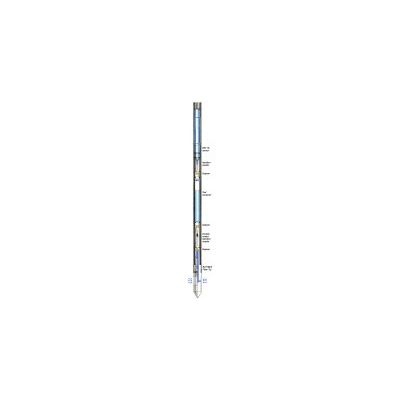
BAT - Model GMS -Permeameter
BAT Permeameter Using the the BAT GMS, in situ hydraulic conductivity tests can be routinely performed, both in unsaturated and saturated soils. The BAT Permeameter combines with the BAT Piezometer equipment and the BAT MkIII Filter tip.
The BAT Permeameter incorporates a Test container. The container is sealed in both ends with a flexible septum.
At its lower end the Test container temporarily interconnects with the BAT MkIII Filter Tip, using a double-ended injection needle. At its upper end the Test container interconnects with the BAT IS pressure sensor, also by using an injection needle. Thus making possible measurement of the pressure, P, inside the Test container.
The BAT Permeability test is based on measurement of the rate of flow into or out of the Test container. This rate is computed by measuring the pressure change in the Test container, which by using Boyle´s law can be translated into a volume change. Analysis of the time-pressure record thus yields the coefficient of permeability, k.
The BAT Permeability test can be performed either as an inflow or as an outflow test. The former type of test, starts with an empty Test container, having a lower starting pressure, P0, than the equilibrium pore pressure, U0, in the tested soil. The outflow test, on the other hand, starts with a partly water filled Test container, having a higher pressure, P0, than the equilibrium pore pressure, U0.
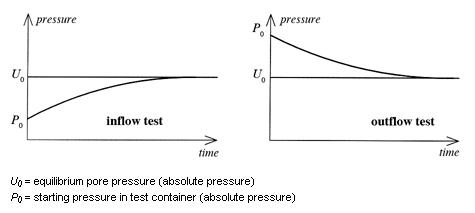
By using the logging function of the BAT IS Sensor, pressure data are collected automatically at a preselected time-interval.
The time-pressure record can be fed directly into a portable computer for an immediate field calculation of the coefficient of permeability, the k –value.
Typical in-situ applications for the BAT Permeameter are:
- control of of k-values of compacted clay liners
- control of of k-values of in-situ slurry walls
- checking quality of containment systems at landfills and tailings dams
- checking design parameters for ground improvement systems, such as vertical drains
- general geotechnical investigation