


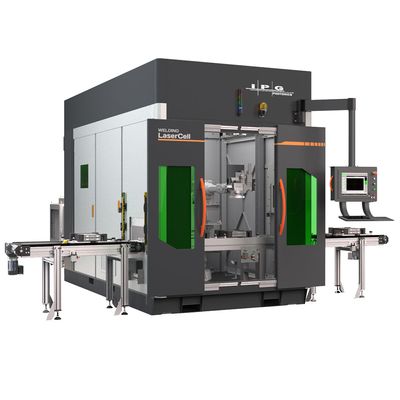
Battery Welding LaserCell
High-Speed Laser Welding with Part Size, Part Loading and Automation Flexibility. The Battery Welding LaserCell is a Class 1 fiber laser processing platform that can be configured with a broad range of welding capabilities and part handling options to suit a wide variety of applications. Featuring a 6-axis robot, the system can bring a laser processing head to a stationary part, or move heavy and complex parts beneath a static laser processing head. With the laser process and part path programming provided by IPG, the equipment configuration can be optimized to suit cycle time, number of part designs, and overall processing flexibility requirements of the user.
Whether the application requires high-speed scanning for many small welds such as busbars or hairpins, or high power continuous welding usually associated with module enclosure sealing, the LaserCell platform has it covered.
- Choice of continuous wave (CW), quasi-continuous wave (QCW) or pulsed lasers
- IPG Proprietary single-mode AMB lasers for high-speed, low spatter copper and aluminum welding
- Choice of scanning head, fixed beam or wobble head options for optimum weld performance
- Laser process development, part path programming and tooling design services available from IPG
- Class-1 laser safe enclosure allows installation in any industrial workplace
- All components except laser source and chiller are internally mounted within a fork truck moveable structure for ease of installation and location flexibility
- Simple facilities hookup requiring only power, process gas and compressed air
- Part-handling options for easy interfacing with up and downstream processing
For complex welding situations, dual robot configurations are available:
Large part with large or extended welded area, large part with many small welding sites processed simultaneously, parts requiring different laser processing.
- Single laser source may service two robots sequentially
- Dual laser configurations support parallel welding of parts
- Separate laser sources and heads can cover different laser operations on the same part
- Robot motions synchronized to avoid collisions while minimizing part cycle time