


- Home
- Companies
- E. Beaudrey & CIE.
- Products
- Beaudrey - Stoplogs - Stop Gates
Beaudrey - Stoplogs - Stop Gates
Stoplogs are used to shut off water intake screen pits for dewatering. They are normally lifted with equal levels upstream and downstream.
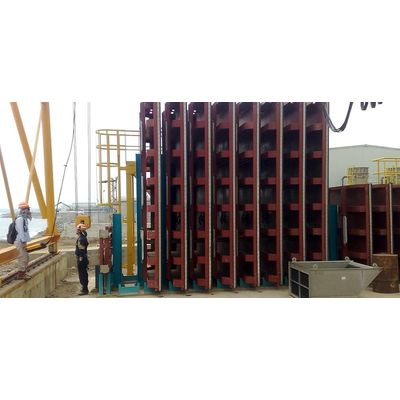
The stoplog system consists of a grouted metallic wall guide in which slides a fabricated metal door.
The guide is made of two vertical channel guides, a top and a bottom sill set with jack screws and grouted into slots in the civil structure.
The stoplog itself is a fabricated door with a thick back plate, stiffening beams and side members. A keynote seal is fitted on all sides and secured with stainless steel fittings. They apply against the smooth surface of the guides for perfect sealing.
One or more level-equalizing valves are provided (actuated from the deck).
When the stoplog aperture is high, the stoplog is made of a number of sections, set one above the other.
- Stoplogs are preferably on-seat but can be either on-seat, off-seat or bi-directional).
There are three types of lifting methods:
-
Using a crane hooked to the lift chain or the self-engaging lift beam.
-
When there is a small level differential between front and back levels, mechanical or hydraulic jacks can be provided.
-
If the gate is to be lifted with a high-level differential between upstream and downstream levels, side rollers and an adequately-sized lifting device are installed. The guides are then of a much heavier gauge.
- Very economical
- Very safe (200% safety coefficient)
- Long-lasting
- Easy to handle
- Very low leakage rate (less than 2 l/min/meter of seal)
- On special request, can be designed for 0.2 l/min/meter of seal (DIN 19569-4 or AWWA C561)
- 3-side sealing:
- The top of the aperture is higher than the high-water level
- 4-side sealing:
- The top sill of the aperture is below the high-water level.
- Standard widths up to 6 m. Larger stoplogs are available on special order.
- Any height can be supplied using multiple elements.
- We can custom-design anything to meet your needs.
- Door:
- Carbon steel is usual, stainless steel on special request
- Guides and stoplog fittings:
- AISI 304L for fresh-water applications
- AISI 316L, duplex or super-duplex stainless steels for salt-water applications
- Sacrificial anodes:
- Aluminium alloy
- In many countries, regulations or by-laws require that for safety purposes, two sets of stoplogs installed in series with their corresponding guides, are required.