


- Home
- Companies
- Egis Group
- Products
- EGIS ProfiTracker - Model CL - Bi-Axial ...
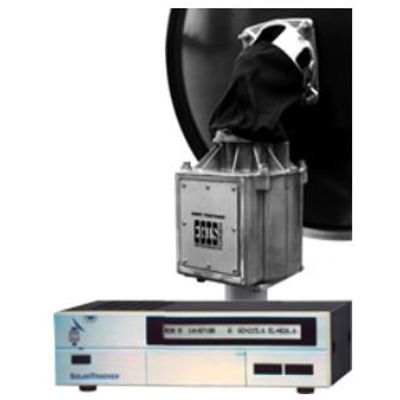
EGIS ProfiTracker - Model CL -Bi-Axial Antenna Positioning System
The advanced satellite tracking system offered by EGIS is designed for precision orientation and tracking of satellites, tailored to both geostationary and inclined satellites. This system integrates a dual-motor-driven azimuth and elevation rotor, facilitating the automated, microprocessor-controlled positioning of satellite dishes. It ensures pinpoint accuracy with a < 0.2° repetition accuracy, eliminating the need for polar mount calibrations. The system's control unit, powered by a 16-bit microcomputer, supports extensive programming options, enabling seamless satellite transitions and field-strength optimizations. Notable features include automatic field-strength adjustment through AGC signals, reducing the risk of signal loss before viewers detect issues. The system is also capable of tracking non-geostationary objects like LEO satellites, facilitated by a two-way RS 232 C Data Interface for real-time adjustments and telemetry signal tracking. These capabilities make it exceptionally suited for use in broadcast applications, large antenna management, and even astronomical pursuits.
- exceptionally simple and fast installation, but highly accurate alignment due to separate motors for elevation and horizontal rotation (azimuth), plus a high-speed positioning computer
- completely equipped: the system consists of an external unit (rotor) and an internal control unit (operating panel with power supply)
- depending on the maximum dish diameter 2.5 m
- no additionally parts between mast top and reflector needed for antenna diameters up to 1.2 m. For exceeding diameters we recommend an individual solution or our special antenna mount
- stylish appearance due to distinctive industrial design
- high operational convenience by pre-programming all geostanionary satellites all around the world up to date. Rotor-Equipment useable from packing-out immediately in all parts of the world, no matter if you are south or north of the equator
- comprehensive information readout during the programming process and every-day operation provided by a 40-symbol alpha-numerical display
- all satellites are identified by name and position
- suitable for the future with 400 satellite memories, allowing the user to individually enter, alter or erase data as desired
- all programming and adjustment operations can be remote-controlled from the location of the receiver set and the control unit! No alignerent-works out at the rotor
- sophisticated electronics allow optimum and most accurate adaptation to any existing system (please refer to detailed program list on Page 6)
- all data and all settings stored in the memories are protected against accidental erase in case of power failure by a long-life backup battery
- important data and settings accessible only after entering a password
- auto-focus, auto-tracking and super-search makes live much easier. Don't forget all the other helping functions (see advanced program listing)
- particularly suitable for using several LNBs (C, Ka, Ku, L, S band and Yagi antennas). The focal point of each feed can be memorized individually!
This basic version is suitable for geostationary satellites, inclining ones*** too.
- with 40 degrees elevation span
- with 180 degrees azimuth turn angle
- with control unit
- with 400 memories, 345 of them preset with actually satellites
- with time-saving logic: in some positioning phases both motors are running simultaneously!
- with receiver interface* (image G), to connect and remote control the sat-tuner and motor drive, with pre-settable take-over speed (1 to 99 pulses/sec.), via four wires only (motor = 5 to 60 V – pulse = max. 50 V, 100 mA) – the 4-wire control cable to the receiver is delivery included
- with simultaneous signal shift-over when both motors are active together!
- with analog input (AGC) for signal-strength dependent positioning optimization** – the operational range of the AGC signal can be matched to the resp. sat-receiver as well in amplitude/ramp as well as in zero point value – (max. 12 V – Signal-
 min. 0.1 V pos. & neg.)
 - for the optimization of performance in private or commercial areas at fixed sat-positions
- for geostationary, but also local inclining satellites
The search and tracking behaviour (AUTO-FOCUS/AUTO-TRACKING) can be influenced motor-sparing by selecting the max. allowed deviation, the timing settings of next search cycle, by determining the search amplitudes, and by determining the search algorithm. Field-strength informations are gained out of the sat-tuners AGC output, (but all other linear systems will do), resulting C, Ka, Ku, L and S band systems can be used. The analogous signals measured are converted into one 8-bit word (0 – 255). The input clock rate/resolution is about 250 Hz! The relative field-strength is shown in the control units display continuously. Long time before the person watching TV remarks any quality loss in the picture, the field-strength optimization is performed automatically, quickly and with highest precision. The AGC cable to the sat receiver are included.
Of course you may search satellites manually with such a system in a perfect way: have a look onto the display and watch AZ- and EL-angles – right-left – upwards-downwards. You may think "more simple is impossible". But you are wrong! Most perfect with – "SUPER-SEARCH": Preset the aperture angle for your antenna (factory preset is the minimum value = 0.1°). Now choose, during installation, any satellite as usual. Due to mechanical montage errors you will miss the satellite – more or less. Now SUPER-SEARCH gets in action. Beginning from the calculated AZ- and EL-angles, the rotor now will concentrically search the sky in increasing circles, corresponding to the opening angle of your antenna. You may find satellites, under circumstances, not being selected. Hence by this key the search-movements can be stopped and started again as well. If you have got the right one, you may start the auto-focussing or optimize manually.
- with 400 satellite memories! Pre-programmed with all geostationary satellites around the globe!
- it can be pre-determined for any single satellite, whether "Autofocus" is performed after selection automatically or, e. g. at inclining satellites, permanent "Auto-Tracking" runs or only one single positioning is done
- with hardware-extension, clock incl. calendar and astronomical sun-tracking-program to prevent the risk of LNB-burnout or LNB-melting, when the formation "sun-satellite-parabolic-antenna in one line" appears. This system permanently compares the actual sun position with the AZ- and EL-angles of the target satellite. If any danger of damaging the LNB by direct centric sun-radiation exists, the system generates an alarm. The user can pre-program, how many minutes before this event a notification should be given out, whether the position is left for a short period of time after a pre-programmed time or whether the transmission is kept continuously and the position is retained. That is a must for any uplink station.
- the wind-sensor-interface is provided to connect a pulse-output wind-anemometer with the 4-wire-interface. After setting "pulse per unit of time" of the wind-sensor and after reaching the wind-speed trigger preset by the user, the unit turns into a more streamlining position also preset by the user (but only within the rotor's range of motion). The delay-time in this position can be preset, too.
- including solid state relay (SSR)
- no contact-burnout, due to mechanically contactless switching
- less noise due to absence of switching or cutoff sparks
- smooth, silent control unit, because no parts are moving
- cultivated two-speed-operation, because semiconductors are switched on and off in high frequency
- more precisely, because different speeds can be driven with solid state switches
- improved tracking behaviour, because the positions can be targeted more precisely by "stopping" and "starting" with reduced speed
- operates complete automatically, resumes operation automatically after power failure
In this version the motors are soft-powered upwards in two steps and slow down in two steps. By this dampened acceleration of masses motor, gear and bearing are less stressed and less abrasion wear occurs. Accuracy and lifetime are kept for a longer time.
"True" soft-start and soft-stop is achieved only with this "Motion Control" "SERVO"-extension. Herewith the acceleration can be defined stepless individually.
In addition this version allows the mounting of the control unit into a 19"-rack plug-in unit "GR-19".