


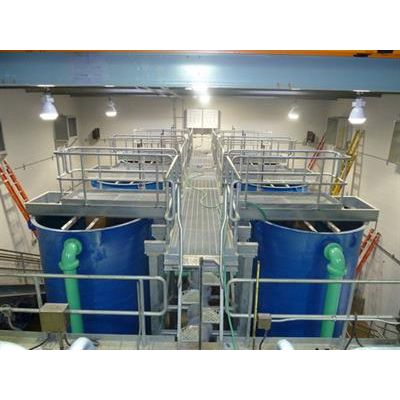
Blue Nite - Biological Denitrification Plant
Fully denitrify your wastewater: If you have nitrate or total nitrogen limits (or anticipate future limits and want to be ready), you need a system that can efficiently remove nitrates. Save space, time and money: Within the tight budgets imposed upon municipalities, implement an effective solution that doesn’t break the capital expenditures bank or multiply operating expenditures down the road.
Nexom is the exclusive provider of Blue Nite biological denitrification, a simple, powerful technology for consistently lowering nitrates to
Why do you need a Blue Nite system? Because nitrate and total nitrogen limits are proliferating in updated discharge permits across the continent, and the Blue Nite system provides a modular, end-of-pipe solution that means you never need to worry about whether you can meet your nitrate levels again.
Implementing Blue Nite biological denitrification has been shown to:
- Reduce nitrates to
- Accommodate high or fluctuating influent nitrate levels
- Work with alternative carbon sources, such as glycerin and acetate
- Work simultaneously in the same vessel with Blue PRO® reactive filtration for phosphorus removal to provide total nutrient removal.
- Nitrate removal to
- Unique patented control system
- Lowest capital and O&M
- Eliminates upsets, gas bumps, and high rate backwash cycling
- Approved for water reuse under California Title 22/Class 1A
- Municipal wastewater treatment
- Industrial nitrate mitigation
- Existing treatment facilities needing end-of-pipe denitrification
- Blue PRO® installations for total nutrient Removal
Blue Nite® systems utilize Nexom’s Centra-flo® continuous backwash, upflow sand filters. A carbon source is dosed to the wastewater influent prior to entering the sand filters. In the Blue Nite system, fixed-film heterotrophic bacteria convert nitrates (NO3- and NO2-) to atmospheric nitrogen (N2). The composition of the bacterial population depends largely on the specific type of carbon utilized. Bacteria and solids wasting are facilitated by the continuous backwash of the Centra-flo filter. The media washbox removes solids and excess biomass, which are directed to a reject line. The clean sand then falls by gravity back to the media bed.
Design hydraulic loading rates to Blue Nite filters are dependent on heterotrophic respiration rates, influent nitrate levels, nitrate variability, dissolved oxygen (DO) levels, and expected range in water temperature. Loading rates can also be dictated by the NPDES permit or local regulatory agencies. Nexom`s design parameters coupled with its proprietary control system optimizes system parameters to maintain a healthy, stable biomass for denitrification.
The nitrogen gas produced during operation is primarily released from the process as the media passes through the airlift. Removal of gas in this fashion has several benefits that include: eliminating false readings in headloss, eliminating the need to backwash because of gas entrainment, and eliminating the gas bump or upset gas "burps" due to significant nitrogen bubble accumulation typical in static bed filters.
Fits easily into existing WWTFsThe Blue Nite system is available in several models and configurations. The modular nature of the filters allows ease of system engineering and expansion. The filters are available as freestanding fiberglass or stainless steel tank units or can be configured in multi-module concrete cells. Control systems and smaller filters may be mounted on skid systems for mobility or ease of commissioning.
Can this system also be configured to remove phosphorus?
Since the same dosing and continuous-backwash mechanics enable Blue PRO® reactive filtration and Blue Nite’s attached growth biological denitrification, the two processes can take place simultaneously in the same tanks for total nutrient removal, with only the Blue Nite’s carbon-dosing system as additional required infrastructure while considering the biological kinetics.
Learn more about the Blue PRO process, or contact us to find out how this capability could impact your plant.