

BorTec GmbH
- Home
- Companies
- BorTec GmbH
- Products
- BoroCoat - Boronizing ExTreme Wear ...
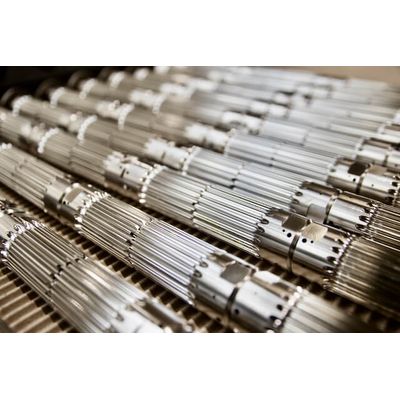
BoroCoat - Boronizing ExTreme Wear ProTecTion
FromBorTec GmbH
BOROCOAT® or boriding is a thermochemical diffusion process in which boron diffuses into the material surface to produce hard, wear-resistant boride coatings.
Most popular related searches
wear resistance
wear protection
chromium
wear protection coating
wear protective coating
furnace
acid protection
protective coating
- High layer hardness of 1,400-2,800HV
- High surface hardness even with unalloyed steels
- Significantly improved adhesion
- High resistance to abrasive wear
- High resistance to adhesive wear
- High thermal resistance
- Pronounced lubricating effect
- Good resistance to Al- and Zn- melting
- High protection in acidic environments
- UNALLOYED STEELS
- LOW ALLOY STEELS
- STAINLESS STEELS
- COLD-WORKED STEELS
- HOT-WORK STEELS
- HIGH-SPEED STEELS
- PM STEELS
- NIMONIC®, INCONEL®, HASTELLOY®, HAYNES®, STELLIT
Boronizing is a thermochemical diffusion process in which hard and wear-resistant boride coatings are produced by diffusing boron into the material surface.
The materials are treated in a temperature range from 750 to 950 °C. Of fundamental importance here is optimum heat distribution in the furnaces used in order to treat all parts of a batch uniformly. During the boronizing process, complex intermetallic compounds are formed between the elements iron, boron, chromium, nickel, vanadium, etc. The resulting borides form a hard surface layer consisting of Fe2B and other compounds.
Due to its crystalline structure, the boride layer exhibits excellent anchorage with the base material. For treatment, the boron donor can be in powder, paste or granular form. Individual, large parts, set material and bulk material can be refined.
With its EKABOR® products, BorTec provides suitable boronizing agents for all requirements. The boriding process is particularly suitable for unalloyed and low-alloyed steel grades. As the proportion of alloying elements increases, the diffusion rate and thus the thickness of the achievable boride layer decreases. At the same time, alloying elements such as nickel and chromium contribute to an increase in hardness and wear resistance.
The range of materials which can be boronized is diverse and extends from cast iron, cast steel, most steel grades to NICKEL BASED ALLOYS and special materials such as Stellite®. Materials containing silicon and aluminum represent a limitation. Steels with correspondingly high contents of the elements mentioned can impair the boriding result.
The materials are treated in a temperature range from 750 to 950 °C. Of fundamental importance here is optimum heat distribution in the furnaces used in order to treat all parts of a batch uniformly. During the boronizing process, complex intermetallic compounds are formed between the elements iron, boron, chromium, nickel, vanadium, etc. The resulting borides form a hard surface layer consisting of Fe2B and other compounds.
Due to its crystalline structure, the boride layer exhibits excellent anchorage with the base material. For treatment, the boron donor can be in powder, paste or granular form. Individual, large parts, set material and bulk material can be refined.
With its EKABOR® products, BorTec provides suitable boronizing agents for all requirements. The boriding process is particularly suitable for unalloyed and low-alloyed steel grades. As the proportion of alloying elements increases, the diffusion rate and thus the thickness of the achievable boride layer decreases. At the same time, alloying elements such as nickel and chromium contribute to an increase in hardness and wear resistance.
The range of materials which can be boronized is diverse and extends from cast iron, cast steel, most steel grades to NICKEL BASED ALLOYS and special materials such as Stellite®. Materials containing silicon and aluminum represent a limitation. Steels with correspondingly high contents of the elements mentioned can impair the boriding result.