


Brechtel
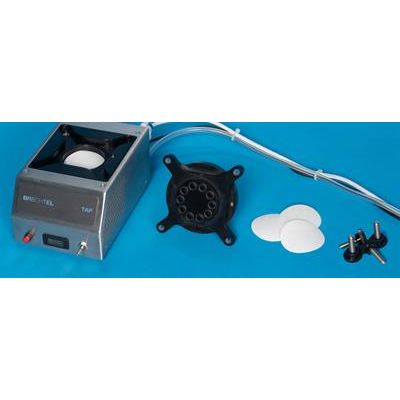
Brechtel - Model 2901 -Tricolor Absorption Photometer (TAP)
FromBrechtel
Perform real-time light absorption and black carbon measurements using light transmission through a filter with the Tricolor Absorption Photometer (TAP). Based on a decades-proven design that is simple to use and maintain, the TAP measures light absorption at three wavelengths by particles deposited on a filter. By assuming a mass extinction efficiency, the ambient mass loadings of black carbon can also be determined. The TAP has been deployed at Global Aerosol Watch sites around the world for many years, demonstrating good agreement with other simultaneously deployed filter-based light absorption methods.
Most popular related searches
absorption photometer
black carbon
black carbon measurement
air quality monitoring
ambient aerosol
air filtration
photometer
absorption measurement
PM2.5
air monitoring
- Eight sample channels and two reference channels
- Easy to operate and install (external pump required)
- Multiple-wavelength light source (Red, Green and Blue)
- Data logging software included
-
Up to 84 days of unattended operation on one filter at a PM2.5 loading of 10µg/m3 and an aerosol single scatter albedo of 0.95
-
Internal heater eliminates RH filter artifact
- Fully characterized and field tested
- Low maintenance
- Up to 84 days of unattended operation at a PM2.5 loading of 10ug/m3 and an aerosol single scatter albedo of 0.95
- Extremely compact – fits inside a 6.3 inch (16 cm) cube!
- Only 5 minutes required to change filter
- Sample flow rate (volumetric) 2 lpm
- Wavelengths 467, 528, 652 nm (365 nm UV option)
- Filter media Glass fiber, 47 mm diameter
- Noise (standard deviation of 60 sec averages on filtered air) +/- 0.2 Mm-1 (0.02 μg/m3 black carbon mass)
- Number of sample spots 8
- Number of reference spots 2
- Power consumption 36 W
- Supply voltage 100-230 VAC
- Operating temperature range 15-35°C
- Dimensions 6.3 x 4.3 x 4.5 in/16 x 11 x 11.5 cm
- Weight 3.6 lbs/1.6 kg
- Mounting holes x4, 6-32 tapped holes on bottom 3.375"x 4.375"/(8.57 x 11.11 cm apart
- Continuous monitoring of ambient aerosol light absorption and black carbon
- Laboratory smog chamber studies
- Visibility reduction studies
- Aerosol health impacts
- Long-term climate and air quality monitoring