


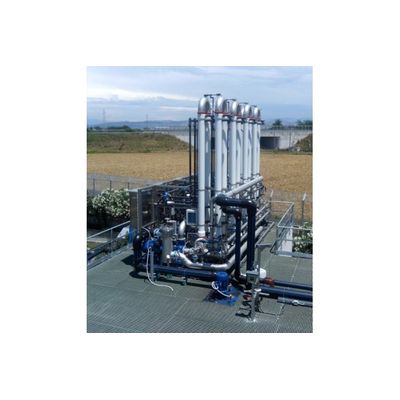
TA - BRM (Biological Membrane Reactor) for Biological Wastewater Purification
The entry into force of Legislative Decree 258/00 in transposition of Community Directives 271/91 and 676/91 and of the recent Decree of the Ministry of the Environment and Territorial Health n. 185 of 12 June 2003 containing the technical standards for the reuse of waste water, led to the introduction of more restrictive regulatory limits regarding the removal of nutrients from waste water .
In particular, the concept of `sensitive area` understood as a receiving body of water exposed to the risk of eutrophication has posed the need for interventions to adapt existing purification plants , often characterized solely by biological oxidation compartments of organic compounds.
However, this need for expansion tends to clash with the ever decreasing availability of surface area for the implementation of conventional activated sludge purification processes, favoring the growing interest of operators in certain types of treatment capable of compacting process volumes and optimizing the quality of the purified water , at the same time making the management of the systems simple.
Membrane biological reactors ( MBR, from the English Membrane Biological Reactor or BRM, membrane bioreactor) derive from the coupling of traditional suspended biomass processes with filtration processes on microporous or ultraporous membranes , depending on the nominal size of the pores. The greatest advantages linked to this technology are to be found in the possibility of eliminating the sedimentation unit downstream of the biological sector and all the management and operational constraints connected to it.
Replacing the sedimentation compartment with a membrane filtration compartment involves:
- A notable reduction in the planimetric dimensions of the purification plant , due both to the disappearance of the sedimentation tank and to the increase in the concentration of suspended solids in the biological reactor;
- The possibility of managing the biological process in a totally independent manner from hydraulic load fluctuations (the cellular residence time and the hydraulic retention time are completely independent of each other);
- The decrease in excess sludge associated with higher sludge age values;
- The elimination of the sludge sedimentation problems usual in traditional activated sludge plants;
- The significant improvement in the qualitative characteristics of the effluent , compatible with the potential reuse of purified water.
Hollow fiber polymeric membrane : porosity 0.1 micron and internal diameter of the fibers 0.3 mm.
- Tubular polymer membrane: porosity 0.03 micron, channel diameter 8 mm.
- Ceramic membrane: porosity 0.05 micron, equivalent channel diameter 3.5-6 mm.
The filtration modules are made up of hollow fibers supported on a sturdy stainless steel frame and connected by means of PVC manifolds.
The support structure of the modules serves to give rigidity to the system. The height of this structure is such as to guarantee that the fibers remain rather "soft", i.e. able to move under the action of the air that is blown from under the module; the modules in fact integrate a second collector for the distribution of air under the fibers by means of a blower.
The air, flowing in the form of bubbles along the fibers, generates a turbulent regime around them which helps to keep the fibers clean.
The modules are completely immersed in the oxidation tanks (or rather in special compartments created therein and kept in communication by means of valves, so that they can be separated for maintenance operations).
Typically, in addition to the membrane module, each system includes:
- A permeate extraction pump (and any air trapped inside the fibres), reversible and capable of creating 0.4 - 0.5 bar in suction. This pump will create a vacuum in the butt connectors where the fibers are sealed with epoxy resin.
- An aeration system to supply air to the membranes. The air is supplied in the form of large bubbles via special diffusers positioned under the membrane modules.
- A "clean in place" circuit, with tank for washing products and possible dedicated pump.
- Possible backwash system.
In the case of submerged membrane bioreactors, the final sedimentation and sand filtration stages are replaced, solving all the problems of poor sedimentability of activated sludge . This also allows you to work with much higher mud concentrations in the oxidation tanks than traditional systems (up to 8-10 gMLSS/l versus the traditional 4 gMLSS/l), with all the related advantages.
- MEMBRANE MATERIAL: PVDF
- POROSITY: 0.03 microns
- PIPE DIAMETER: 5-8-10 mm
- MAX PRESSURE : 8 bars
- WASHING CONDITIONS (pH): 2
- WASHING CONDITIONS (TEMPERATURE): Tmax=60°C
- BACKWASH: YES