


- Home
- Companies
- Tenova S.p.A.
- Products
- Tenova - Bucket Wheel Excavators
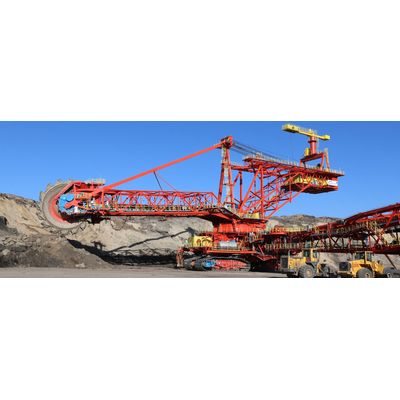
Tenova - Bucket Wheel Excavators
Bucket-wheel excavators (BWEs) are continuous mining machines for overburden (semi-hard material such as clay, sand, gravel, marl, etc.), lignite and hard coal.
TAKRAF BWEs can be employed across a wide-variety of commodities and our machines cover a wide-range of capacities, all the way up to 20,000 m³/h, with working bench heights varying from less than 5 m to approx. 50 m. In most applications, the BWE is connected to a belt conveyor system or a cross-pit spreader.
Various Machines Sizes for Various ApplicationsOur systems are all specifically designed to our client`s requirements and incorporate various solutions according to their specific application, including actual site conditions. As a result, either compact or large scale BWEs can be employed, depending on the required cutting height, block width and length of the working bench.
Compact excavators are most suited to mines with short benches and harsh, irregular operating conditions; whereas large machines are more suited to working in flat mines with unconsolidated rock, large benches and regular mineral deposits.
Optimized Excavator Design for Specific Project RequirementsThe principal components of a BWE are the bucket-wheel with its buckets, the bucket-wheel drive at the head of the wheel boom, the slewable superstructure with counterweight boom, the substructure with crawler undercarriage and a transfer boom or loading unit (crawler-mounted loading bridge) for transfer of material to the bench conveyor. Excavator design hence always aims to meet specific demands and requirements of the project in terms of optimization, standardization and maintenance.
100 Years of Experience and Counting...BWEs are among the largest terrestrial vehicles ever constructed. The largest excavator ever built, the TAKRAF SRs 8000, has a weight of 14,200 tons and moves 240,000 m³ (bank) of overburden per day - but this is just one example of a machine taken from an extensive history, dating back almost 100 years, of TAKRAF excavator tradition, experience and execution.