


- Home
- Companies
- Platipus Anchors Limited
- Products
- Buoyancy Control
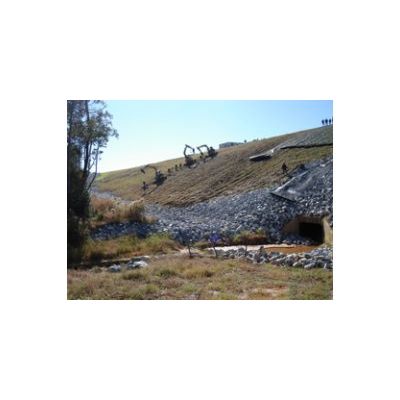
Buoyancy Control
Platipus Anchors are market leaders in the design, manufacture and supply of mechanical earth anchoring products. The company is renowned for providing some of the most innovative and cost-effective anchoring solutions for the Civil Engineering, Construction and Marine industries.
The percussion driven earth anchor (PDEA) is a unique, modern and versatile device that can be quickly installed in most displaceable ground conditions. It offers a lightweight corrosion resistant anchor that can be driven from ground level using conventional portable equipment. It creates minimal disturbance in the soil during installation; can be stressed to an exact holding capacity and made fully operational immediately.As a completely dry system it also has minimal impact on the environment.
- Proven design solutions for buoyancy control of small & large pipelines
- Significant time & cost savings over concrete coating / set on / bolt on weights / bags
- Minimal environmental damage
- Proof testing of each anchor upon installation
- Application designed webbing for fast installation with no damage to pipes or their coating
- Installation before or after the pipe is laid
- No specialist installation equipment required
- Flexible anchor selection for varying soil conditions
- No Cathodic protection required
The stress distribution in front of a loaded anchor can be modelled using foundation theory. The ultimate performance of an anchor within the soil is defined by the load at which the stress concentration immediately in front of the anchor exceeds the bearing capacity of the soil.
Factors that will affect the ultimate performance of the anchor include:-
- Shear angle of the soil
- Size of the anchor
- Depth of installation
- Submerged Conditions
Platipus anchors perform exceptionally well in a granular soil, displaying short loadlock and extension characteristics, a broad frustum of soil immediately in front of the anchor and extremely high loads.
Stiff cohesive soils, such as boulder clays, can also give outstanding results. However, weaker cohesive soils, like soft alluvial clays, can result in long loadlock and extension distances and a small frustum of soil in front of the anchor. Consequently these conditions require a larger size of anchor and if possible a deeper driven depth to achieve design loads.