


Carbon Nanotechnology
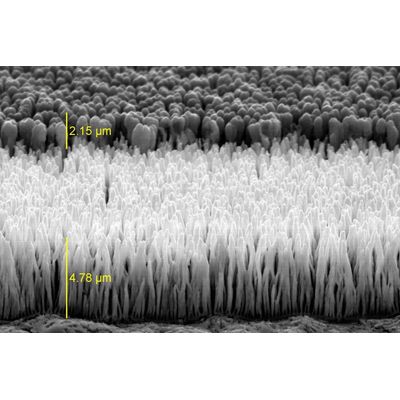
Smoltek’s patent-protected technology platform enables controlled growth of precisely localized and defined nanostructures, as individual fibers or clusters, in predefined patterns or films. This is done in a through catalytic growth in a vacuum chamber using gas and catalysts. Materials and process conditions are compatible with industrial requirements. We have developed unique growth recipes using which we can grow carbon nanostructures at exact positions with exact required properties. This is our core technology, and it goes by the name SmolGROW™. Partners can license our technology to accomplish solutions tailored to their unique needs and requirements.
Carbon nanofiber is a super material. It is stronger, more elastic, and lighter than steel. It conducts heat and electricity better than metals. And it can be used to thousandfold the surface of materials.
A carbon nanofiber (CNF) is a material entirely made of carbon so thin that its diameter is measured in nanometers (nm). Its length is many times longer than its diameter. CNFs have diameters in the range of 5–500 nm and lengths in the range of 1–200 micrometers (µm).
A nanometer (1 nm) is one-thousandth of a micrometer (0.001 µm). That’s so tiny that only three free carbon atoms fit on a straight line of that length.1 To get an idea of how extremely small that is, let’s imagine a strand of human hair. If you split it lengthwise, then split the two halves again, and then repeat this over and over again until you have 70,000 strains from that single strand, each of them is about 1 nm thick.2
Carbon nanofibers are ten times stronger than the strongest steel in the world (maraging steel) and up to a hundred times stronger than ordinary steel.
The tensile strength of carbon nanofibers is a mind-boggling 30 gigapascals (GPa).
Suppose you have a round bar with a diameter of 1 cm and the same tensile strength as carbon nanofibers. Let’s assume you somehow manage to hang a mid-size car from its end. Then you add another, and yet another, and so on until the round bar breaks. Can you guess how many cars were hanging from the round bar before breaking? Two hundred! That’s how strong carbon nanofibers are.
Therefore, carbon nanofiber is an excellent building block at the microscopic level. It can be used as a support or reinforcement bar (“rebar”) for materials that become brittle at small sizes. They can also be used as tiny spacers between layers of materials. Or as needles that make microscopic holes in membranes.
If you were going to bend a carbon nanofiber, you’d better think again. It requires four times more force to bend or stretch carbon nanofibers than steel. And that stubborn little straw would return to its original shape as soon as you let it go. Like a rubber band.
The Young’s modulus (describes the property of a material that tells us how easily it can stretch and deform) of carbon nanofibers varies between 80 and 800 GPa.
Although a carbon nanofiber is much stronger than steel, it weighs only a quarter of steel. The density of carbon nanofiber is between 1.3 and 2 g/cm3.
Imagine a steel cube with sides 10 cm long and a carbon nanofiber cube of the same size. If you put them on separate scales, the one with the steel cube will read 8 kg, while the one with the carbon fiber cube will read less than 2 kg.