


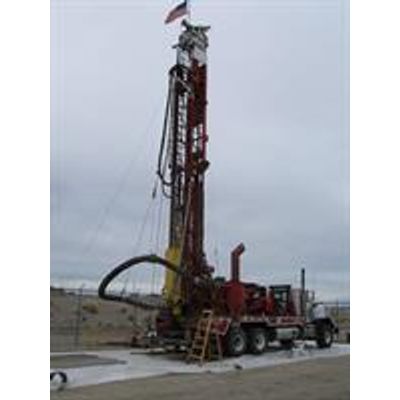
Cascade - Rotary Core Drilling Bit
Rotary technology uses a sharp, rotating drill bit and downward pressure to cut, or crush, through the subsurface. Impact energy is supplied to the drill bit from either an above ground or down hole impact hammer. This impact force aids in the drilling. Depending on the competency of the substrate, the drill casing is advanced as the hole is cut, keeping the hole open during drilling. Competent rock may be drilled "open hole", not requiring the use casing..
There are a number of different rotary methods and techniques, each suited to perform under different subsurface conditions. They differ in the way drill cuttings are removed. Continuous removal of drill cuttings is required in all rotary methods to keep the hole clean and the bit moving freely. Cascade offers air rotary, mud rotary, dual rotary, and reverse circulation technologies.
- ROBUST Rotary methods effectively advance through hard and soft lithology.
- DEPTH & DIAMETER Rotary advances to deeper depths than direct push and auger, and is capable of larger diameter holes.
- VERSATILITY Several variations of rotary technology are available; each offering unique advantages based on the geology, site conditions, and scope of work.
Air rotary drilling is a method used to drill deep boreholes in rock formations. Borehole advancement is achieved by rapid rotation of a drill bit which is mounted at the end of the drill pipe. The drill bit "cuts" the formation into small pieces, called cuttings. This method utilizes air as a circulating medium to cool the drill bit, bring drill cuttings to the surface and maintain borehole integrity. Once the air and cuttings return to the surface they are captured in a cyclone where the cuttings drop out the bottom. Standard split-barrel and thin-wall sampling are not utilized with this method. A broad range of coring equipment is supported for consolidated rock.
There are several variations in air rotary techniques including: direct air rotary casing hammer (ARCH), down hole hammer, and under reaming.
In ARCH, often called "top drive", both rotational down force and impact force are provided by an above-hole impact hammer and a rotating drill head. Drill cuttings are removed from the borehole by the injection of high pressure compressed air, down the middle of the drill rod, exiting out of the annular space between the drill rod and borehole. Samples of the substrate from the direct air method are often thought to be less correlative to the depth of the bit face.
Under reaming is a variation of the top drive casing advancer method that uses a rotating cutting bit in front of the advancing casing. The bit cuts a slightly larger diameter hole than the outside diameter of the casing. The larger diameter hole allows the casing to be more easily advanced in tight formations and in deeper drilling applications where the longer drill stem encounters significant side wall friction.
Mud RotaryMud rotary is often used in soft sediments that may or may not be saturated with groundwater. Borehole advancement by mud rotary drilling is achieved by rapid rotation of a drill bit which is mounted at the end of drill pipe. The drill bit cuts the formation into small pieces, called cuttings, which are removed by pumping drilling fluid, called mud, through the drill pipe, out the drill bit and up the annulus between the borehole and drill pipe. The drilling fluid is also used to cool the drill bit and stabilize the borehole wall, prevent fluid loss into the formation and to reduce cross contamination between aquifers. Once the mud returns to the surface, it is captured in a mud pan where the cuttings settle to the bottom and the mud is recirculated down the borehole. Additional mud is introduced as the borehole gets deeper and fluids are lost to the formation.
Standard split-barrel and thin-wall sampling are available in unconsolidated formations, while a broad range of coring equipment is supported for consolidated rock. Hydrologic conditions have little effect on mud rotary drilling and operations usually are unhindered by the presence of ground water. Mud rotary drilling readily supports the telescoping of casings to successively smaller sizes. This isolates drilled intervals and protects lower geologic units from contamination by previously drilled and contaminated upper sediments. Mud rotary drilling can be a more advantageous method verses hollow stem auger drilling. It is a very fast and efficient way of drilling that is adaptable to a wide range of geologic conditions. Only exceptionally large, poorly stabilized boulders or cavernous conditions are unsuited for mud rotary drilling.
Dual RotaryDual rotary technology delivers powerful performance in unconsolidated overburden (sand, gravel, cobbles, and boulders) where other technologies struggle to drill a cased hole. This advantage makes dual rotary one of the most efficient and cost effective methods for drilling holes in difficult formations.
Unlike other drill rigs which use only an upper drive, dual rotary uses both an upper and a lower head drive to advance the drill bit and casing. Rotational forces are transmitted to the casing via power-operated jaws. A carbide-studded shoe, welded to the end of the first piece of casing, enables the casing to cut its way through the overburden. A top drive rotary head simultaneously handles a drill string equipped with either a down hole hammer, drag bit or rolling cone bit to drill the center.
Reverse CirculationIn reverse circulation, rotational and impact energy are delivered in the same manner as direct air rotary. However, samples are obtained when high pressure compressed air is injected down the annular space between the drill rod and borehole, and exits up the middle of the drill rod. Samples of the substrate from the reverse circulation method are often thought to be more correlative to the depth of the bit face and are favored in mineral exploration.
The WATERLOOAPS was originally designed and tested at the University of Waterloo by chemical hydrogeologists and is the only tool of its type to have been subjected to such scientific testing. Drag down, or cross contamination, is minimal in comparison to other tools. The profiler does not need to be tripped between samples and, due to its stainless steel sampling train, is free of sorption and desorption associated with tools using polymer tubing.
Real time hydrostratigraphic profiling in the same push with discrete depth sampling, without withdrawing the tool between samples, allows for very efficient high-resolution groundwater contamination investigation.
KPRO helps us select depths at which to collect samples based on changes in stratigraphy as opposed to random or predetermined “blind” intervals. The IK and sample collection are accomplished in a single push to obtain data more quickly and cost effectively.
It enables a better understanding of the site’s hydrostratigraphy for the creation of more accurate conceptual site models and flow and transport models.
It identifies impermeable zones so time is not wasted trying to collect water samples in suboptimal locations. Low permeability zones can, and should, be sampled using high-resolution soil sampling techniques. By sampling the interfaces of high and low K zones the WaterlooAPS data can identify where those aquitard materials are likely to contain contaminant mass and therefore should be targeted for detailed soil core profiling and analysis.
The KPRO system incorporated into the WATERLOOAPS is the original injection logging hydraulic profiling tool. As the tool is advanced, clean water is injected into the formation while depth, pressure, and flow rate are monitored. From these data, a real-time continuous log of the Index of Hydraulic Conductivity is calculated. It is not necessary to drive the tool once to log the hydrostratigraphy and again to sample—both are accomplished in a single push. Hydraulic head distributions can be determined if a common datum is established for the site and the ground surface elevation is known. In shallow water table conditions the depth to the potentiometric surface is measured using an uphole transducer. If the water table is deep (greater than the suction limit ~ 27 ft bgs) then a downhole transducer can be used to measure the pore pressure and converted to a hydraulic head.
-
WATERLOOAPS 225 A 2.25-inch OD version is the most robust model, built to be used with the Geoprobe 8040 rigs for maximal depth penetration. The tip has more open area for higher sampling rates and reduced clogging. The 225 can be used with either a peristaltic pump or with the downhole nitrogen drive positive displacement pump.
-
WATERLOOAPS 175 The 1.75-inch OD version is the same diameter as the original Waterloo Profiler but utilizes more durable direct push rod and has the unique APS tip design.
-
WATERLOOAPS 150 This small diameter version has an OD of 1.5-inches. Compared with the 175, the 150 is sometimes able to achieve better depth penetration due to the smaller diameter. In situations of limited access, the lighter and smaller 150 rods can be an advantage.
- The APS can be fitted with a Wenner array electrical conductivity logging tool to allow assessment of zones with high ionic strength pore fluids (brines, leachate etc). The EC log, in combination with the IK and the sampling capability, allow for very targeted and effective sampling in environments where high ionic strength pore fluids are of interest.