


CPL CONCORDIA Soc. Coop.
- Home
- Companies
- CPL CONCORDIA Soc. Coop.
- Products
- CPL CONCORDIA - Model Biopower (M-J) - ...
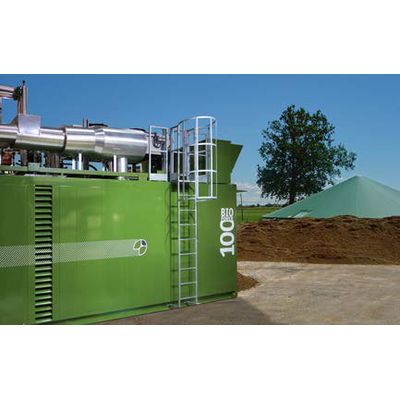
CPL CONCORDIA - Model Biopower (M-J) -Co-Generation Module
Biopower is a plug & power product line ready for use branded CPL CONCORDIA. It has been designed for biogas co-generation from 100 kW upwards.
Most popular related searches
solid urban waste
greenhouse gas emissions
solid organic waste
greenhouse gas
gas emissions
organic waste
waste storage
H2S
sewage sludge
organic urban waste
| BIOPOWER M model? | Power input kW | Electric power kWe | Thermal power kWt | Electrical yield % | Thermal yield % | Total yield % | Fuel consumption (*) Nm3/h | Power supply system | Dimensions (LxDxH)?mm | Weight kg |
| BIOPOWER 100 M | 274 | 100 | 132 | 36,5% | 48,2% | 84,7% | 54 | Turbo intercooler | 3610x1200x2100 | 3410 |
| BIOPOWER 210 M | 531 | 210 | 234 | 39,5% | 44,1% | 83,6% | 105 | Turbo intercooler | 3810x1500x2250 | 5150 |
| BIOPOWER 250 | 657 | 250 | 326 | 38,1% | 49,6% | 87,7% | 130 | Turbo intercooler | 4500x1800x2450 | 6250 |
| BIOPOWER 355 | 924 | 355 | 433 | 38,4% | 46,9% | 85,3% | 182 | Turbo intercooler | 4500x1900x2450 | 7150 |
| BIOPOWER 450 M | 1179 | 450 | 556 | 38,2% | 47,2% | 85,3% | 233 | Turbo intercooler | 5000x1900x2650 | 7850 |
| BIOPOWER 530 M | 1358 | 530 | 654 | 39,0% | 48,2% | 87,2% | 268 | Turbo intercooler | 5500x2200x2750 | 8540 |
|
BIOPOWER J model?
|
Power input kW | Electric power kWe | Thermal power kWt | Electrical yield % | Thermal yield % | Total yield % | Fuel consumption (*) Nm3/h | Power supply system | Dimensions (LxDxH)?mm | Weight kg |
| BIOPOWER 299 J | 771 | 299 | 371 | 38,8% | 48,2% | 87,0% | 152 | Turbo intercooler | 4900x1700x2000 | 5900 |
| BIOPOWER 599 J | 1505 | 599 | 713 | 39,8% | 47,3% | 87,1% | 296 | Turbo intercooler | 4700x1800x2300 | 9500 |
| BIOPOWER 901 J | 2132 | 901 | 905 | 42,3% | 42,4% | 84,7% | 474 | Turbo intercooler | 6000x1800x2200 | 11400 |
| BIOPOWER 999 J | 2488 | 999 | 1131 | 40,2% | 45,5% | 85,6% | 489 | Turbo intercooler | 5700x1900x2300 | 14400 |
| BIOPOWER 1200 J | 2834 | 1203 | 1205 | 42,4% | 42,5% | 85,0% | 630 | Turbo intercooler | 6700x1800x2200 | 13700 |
| BIOPOWER 1500 J | 3538 | 1500 | 1504 | 42,4% | 42,5% | 84,9% | 786 | Turbo intercooler | 7100x1800x2200 | 16900 |
- Power generation from the waste produced by animal husbandry and farming to generate extra income
- Less issues with bio-waste storage and disposal
- Sewage stabilisation: degradation and fermentation processes slow down and produce less foul-smelling compounds. In addition, the odorous substances developed during the process (hydrogen sulphide, mercaptans, ammonia) are delivered to the combustion process
- Use of energy sources alternative to conventional fuels
- Low-profit crops with high energy content can be used with great economic benefits
- Digestate can be used and sold as soil improver instead of chemical fertilisers
- Reduction of greenhouse gas emissions
A great variety of materials can be treated to obtain biogas through anaerobic digestion:
- Energy crops: maize, sorghum, triticale, rye grass, etc.
- Crop residues
- Animal sewage
- Sewage sludge
- Wet fraction of solid urban waste
- Organic waste from agri-food and slaughterhouse industry