


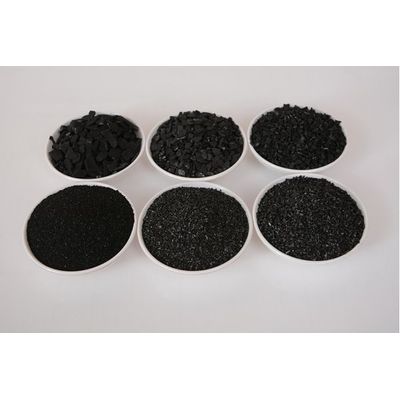
Coconut Shell Activated Carbon
Activated carbon is made from coconut shells, peat, hard and soft woods, lignite, bituminous coal, olive kernels and various special materials. This highly porous adsorption medium is manufactured by chemical or high temperature steam activation and has a complex structure consisting mainly of carbon atoms. Its network of pores within a rigid carbon skeleton consists of disordered layers of carbon atoms that are linked together by random chemical or carbon bonds. These carbon layers are stacked unevenly, forming structures with cavities of various shapes and sizes between the layers. The basic mechanism by which activated carbon removes impurities from a gas or liquid by attracting molecules into this network of pores is called adsorption. Adsorption is the key to the performance of activated carbon.
Coconut activated carbon (AC) is also more environmentally friendly or green. The coconut tree bears coconuts three times a year. The tree is not killed to harvest coconut shells; therefore it comes from a renewable resource. In addition, some of the carbon dioxide produced during the manufacture of coconut shell carbon is removed by the coconut tree and produces oxygen.
Coconut shell is the best activated carbon because it has many so-called micropores, which are the smallest type of pores. Coconut activated carbon can capture more VOCs and other contaminants from drinking water. It is difficult to make it last longer and is a renewable resource that grows on trees.
Coconut activated carbon has a very high hardness and is more abrasion resistant than any other type of activated carbon. It is a completely natural, environmentally friendly product with a very small carbon footprint because it comes from coconut shells. Because most of its pore structure consists of micro-pores (more than 80%), coconut shell carbon can effectively absorb impurities with a micro-pore molecular structure, such as those present in drinking water. In addition, due to its high abrasion resistance and excellent chemical and physical properties
- Coconut activated carbon is produced from coconut shells by a two-step process.
- The first step of activation involves carbonizing the Coconut in order to expel approximately two-thirds of the volatiles from the Coconut shells, resulting in a carbonaceous substance filled with tiny pores.
- In the second stage, this carbonized substrate is activated in steam at high temperatures (1,100°C/2,012°F). The activation temperature and activation time are important for creating the internal pore network and imparting certain surface chemistry within each particle. Essentially, the entire activation process imparts unique adsorption properties to the carbon.
It is widely used in the purification, decolorization, dechlorination and deodorization of drinking water, purified water, food, beverages, alcohol, high-purity water, gold refining, electric power, petroleum and other industrial sewage; it can also be used in the desulfurization of the oil refining industry.
- Portable water purifiers
- Wastewater purification
- Gold absorption from gold solutions (precious metal recovery)
- Organic impurity removal in food and beverage applications
- Medical applications
- Catalyst support
The advantage of coconut shell activated carbon over other activated carbons is that it has a good hardness while ensuring a high specific surface area. In addition, coconut shell activated carbon is convenient to use, has obvious effects, is environmentally friendly, has no secondary pollution and toxic side effects, and has a long-lasting effect.