

IRGAS - Combustion Analyzer
CIC Photonics, Inc. is dedicated to providing today’s combustion industries with the highest sensitivity and fastest time response instrumentation. Our IRGAS Combustion Analyzers are used worldwide in a variety of different combustion arenas, and although CIC Photonics has a set of core systems, we pride ourselves on truly meeting the needs of our customers by adapting the core analyzers to their specifications.
Our IRGAS Combustion Analyzer incorporates a rugged FTIR spectrometer with a stainless steel 4m 4Runner gas cell. This combination produces an analyzer that can handle some of the most demanding combustion applications, while still providing high energy throughputs of 36-48 %. The IRGAS Combustion Analyzer is ideal for applications requiring limits of detection in the ppm level, and has rapid gas exchange due to it’s low internal volume and plenum flow geometry.
Auxiliary analyzers can be integrated into the IRGAS Combustion Analyzer . Some of these instruments include those required to monitor O2, H2, and THCs. A Smokemeter can also be included to analyze the filter smoke number of the combustion process.
An IRGAS Combustion Analyzer can be designed to analyze multiple sampling points separately or simultaneously , and have the manifold operated through the system’s software program.
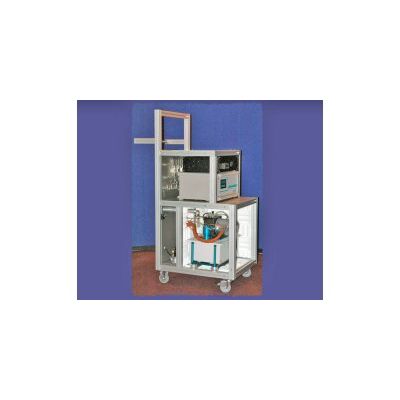
These analyzers can be placed in transportable cabinets or in a rack mount configuration for easier use and “curb” appeal.
Included with the IRGAS Combustion Analyzer is CIC Photonics’ SPGAS analytical software package. This package does everything from concentration tracking and hardware managing to allowing the user to recalculate previously collected data within minutes.
Each IRGAS Combustion Gas Analyzer is incorporated with CIC Photonics SPGAS analytical software package. The standard package for combustion analysis includes the following softwares: IRGAS 100 or IRGAS 100 with SpectraStream, Qmax, Configuration Manager, and Reprocessing T ool. Accompanying software can be added to the standard package to obtain a more automated solution. With the use of automated valves on a multipoint manifold there comes a need to program the valves operation. The IRGAS Script Editor software allows the user to create a “program” of when to open and close valves in the desired sequence for the necessary length of time. Also included in the Script Editor software is the means to program purging and waiting periods. These programs provide a unique solution to analytical problems. All of the programs are extremely user friendly so that the programs can be operated by anyone regardless of skill level. The IRGAS 100 software provides real-time monitoring of species concentration, while also having the capabilities to control various hardware components within the system. Some of the hardware components that can be managed by the software are valves, pressure transducers, temperature controllers, etc....
To accommodate additional analyzers (O2, H2, THC analyzers) the IRGAS 100 can be formatted to report the supplementary analyzers outputs, including these values in the quantification log created by the IRGAS 100, and alert users to alarms/issues with those analyzers.
Having the IRGAS 100 with SpectraStream allows the user to view changes in species concentrations within seconds of the changes happening through the program’s Fast Concentration Tracker by decreasing the response time that is typically associated with FTIR. It also displays a 16 scan added average concentrations of species.
The systems calibrations are generated in the Qmax program which permits the user to generate calibrations easily and/or add new species to preexisting calibrations. In addition to creating new calibrations, Qmax can be used to apply correction factors to current calibrations.
The IRGAS Configuration Manager is a program that contains all of the information regarding the system in one central location. In the Configuration Manager the user can find various parameters for the system that can altered to their needs.
Our most recent program added to the software package is the Quantification Reprocessing T ool. This program allows the user to recalculate data that had been previously collected. Instead of having to recollect data for temperature and pressure changes, a user can enter the new parameters in the Quantification Reprocessing T ool and the program will recalculate the data with the new parameters. As well as recalculating new parameters, it can reprocess new calibration files that have more or less species being quantified. The Quantification Reprocessing T ool can also be used to determine the accuracy of a calibration file and help to determine the correction factor needed for calibrations. Collected spectra can also be displayed and viewed sequentially in the Quantification Reprocessing T ool allowing the viewer to see slight changes in the spectra.