


- Home
- Companies
- Burak Metering Pvt Ltd
- Products
- Burak - Compressed Air Flow Meter
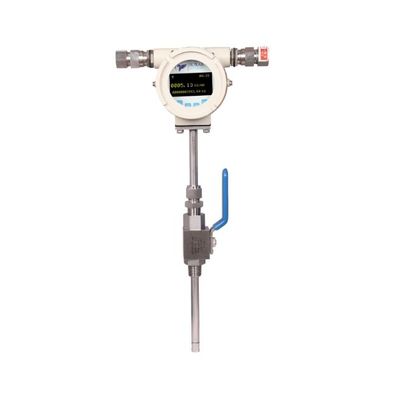
Burak - Compressed Air Flow Meter
Burak’s compressed air meters are accurate, easy to put in, haven`t any moving parts, and best suitable solution for measuring compressed air.
It can measure mass flow, volumetric flow, temperature, and pressure. It can measure the flow up to the velocity of 100 nm/s and doesn`t require any additional pressure and temperature compensation.
The portable compressed air flow meter is meant to satisfy the industrial norms for airflow measurement with data logger and communication features and also provides a web monitoring solution which is a simple and effective way to manage and improve operation.
BURAK Metering is a manufacturer, supplier, and exporter ofcompressed air flow meters in India.
Compressed air flow measurement works on constant temperature difference technology. It operates by observing the cooling effect over a heated transducer because of the passage of gas molecules through a closed conduit pipe.
There are two sensors one is a temperature sensor and the other is the heater sensor.
The temperature sensor monitors the actual gas temperature whilst the heater transducer is maintained at a constant differential temperature by utilizing the specified current from the system to maintain its differential temperature.
The thermal dispersion principle measures the direct mass flow of gas regardless of the change in temperature and pressure in the pipe thus making compressed air flow measurement easy.
Burak’s thermal dispersion mass flow meter is out there in two styles, an inline airflow meter or a portable airflow meter. Standard models include a brightOLED displayfor viewing flow, flow total, temperature, pressure, Analog signal output, RS485, RS232 Modbus RTU Protocol, Flow Alarm, data logging facility, online monitor device (IoT) along.
The digital air flow meter has integral keypads for setting parameters like signal span, pulse frequency, communication, pipe area, flow unit selection, etc.
A cfm meter for compressed air flow meter comes with the inline model from ¼” to 2” and insertion model with 1” up to 12” and larger size on request. Both inline and insertion models of airflow meter accompany wetted parts of stainless steel and Ingress Protection for the electronic enclosure.
- Thermal mass flow meter with the compact or remote flow transmitter
- Thermal dispersion flow meters have low flow sensitivity to change in flow velocity, thus provide an accurate reading
- 316L flow sensor probe for long last life
- No external temperature and pressure compensation needed
- No moving parts and low maintenance work need after installation
- Inbuilt data logger
- Portable model for different pipe sizes
- Various gas sensor sizes available
- Electronic flow meter with pulse or 4-20mA output, RS485, also alarm switches
- Digital display: Bright OLED display to show instant flow and total flow
- Online monitoring for remote location
- Turn down ratio: Normal 100: 1
- Output Signal: 4-20mA, RS485 or pulse
- Flow Sensor Material: 316 Stainless steel
- Protection level: Weather proof
- It measures direct gas mass flow
- Independent of change in pressure, density and viscosity
- It offers higher accuracy
- Negligible pressure drop
- Pressure and temperature compensation aren’t required
- Large turndown ratio
- It has no moving parts
- Rugged in construction
- Inbuilt flow conditioner reduce upstream straight-run requirements
- Wide range of process connection
- Flow-range adjustment and validation and diagnostics
- Field rangeability
- An insertion version for pipes/ducts
- Computer interface software
Compressed air has a wide selection of applications in industrial segments. In every manufacturing facility within the world, compressed gas systems are used as power sources for the operation of tools and equipment. After water, gas, and electricity, compressed air is taken into account to be the “fourth utility”. Compressed air uses more electricity than the other sort of equipment in plants. Compressed air is expensive aside from three utilities in comparison by cost per delivered unit of energy. There are six general aspects of efficient compressed dry air system-total demand, system storage, output air quality, operational supply, on-demand distribution, and overall management. of these six elements got to work together to succeed in its extreme efficiency for the system.
Compressed air is a rich medium, many compressed air systems are wastefully managed and with minimal system transparency in their plant. Frequently large amounts of money and time are expended in optimizing the assembly side of a compressed air system, but generally, the operator has no idea if the upgraded equipment is producing air as efficiently needless to mention or if that efficiently produced compressed air wastes significant amounts through leaks or misused. A typical plant that has not been well maintained will likely have a leak rate of roughly 15-20%. One of the only possibilities to avoid these costs is to precisely monitor volume flow data which may be needed for intelligent energy management, Identify potential savings, overloads and weak points in your system to reinforce its efficiency.