


ConeTec
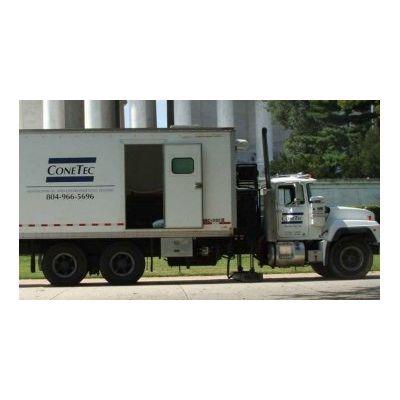
ConeTec - Cones and Data Acquisition Systems
FromConeTec
All ConeTec cones and data acquisition systems are built seismic ready. The addition of geophones in the CPTu body enables the collection of seismic wave data, and the calculation of shear (Vs) and compressional (Vp) wave velocities during the cone penetration test.
Most popular related searches
data acquisition system
cone penetration test
wave velocity
cone penetration
seafloor
seismic
geophone
seismic data
earthquake
wave recorder
Shear waves have particle motion perpendicular to the direction of travel. A normally loaded beam is struck horizontally on each side to create polarized shear waves at regular depth increments. Manual, automatic, and vibratory sources are available depending on the application and rig used.
Compression waves have particle motion parallel to the direction of travel. A vertical impact source is typically used as the source.
- All ConeTec CPTu systems are seismic ready
- Up to 3 geophones per cone (XYZ) axis
- 16 bit data collection
- Multiple shear and compression wave source options
- Offshore ready (sea-bottom mechanical seismic sources)
- >175 m depth capability
- Typically 1m layers are measured and reported, other intervals possible
- Most efficient, accurate, and economical method to measure soil Vs and Vp
- Shear wave velocity is a fundamental geotechnical soil parameter collected independently of other CPTu data
- Two independent cyclic liquefaction evaluations may be conducted using a single SCPTu test
- Both Vp and Vs may be collected during a single SCPTu sounding
- Stacked wave arrivals are recorded to ensure repeatability and to increase velocity precision
- Earthquake engineering (ie - SHAKE analysis)
- Cyclic liquefaction evaluation (CRR-Vs and CRR-Qt1)
- Vibrating machine foundations
- Deep foundation design (soil-structure modulus)
- Shallow foundation design / settlement (soil modulus)
- Unusual soil identification (ie - cementation)
- Soil saturation; Vp drops dramatically when the soil is less than ~98.5% saturated.
- Poisson’s ratio determination
- Gaseous soils (marine silts, bituminous tailings, organics)
- Liquefaction potential is subdued in gaseous soils
- Detecting unsaturated zones