

- Home
- Companies
- Accurate Corrosion Control Inc.
- Products
- Rota-Cell - Constant Contact Reference ...
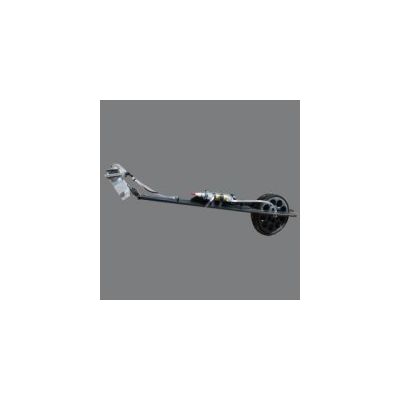
Rota-Cell - Constant Contact Reference Electrode
ROTA-CELL is a Constant Contact Reference Electrode (U.S. Patent 7446522). ROTA-CELL is the reference electrode `accessory` for constant soil contact during Close Interval Survey.
It’s used for performing over the line close interval surveys.
- The reference electrode remains in continuous contact with soil through a water pathway during the survey. Permitting the surveyor the option of triggering data on a timed cycle, by footage or to view a constant profile.
- Easily mounts to the hitch of an ATV or truck.
- Use with any standard “plastic” water tank.
- Use your existing data logger or voltmeter, standard reference electrode and backpack.Survey foreign pipeline crossings or any other area where stray current interference is suspected.
General
The Rota-Cell is designed to allow a technician working alone, or with minimal assistance, to cost effectively perform close interval (or continuous potential profile) surveys of buried pipelines. The technician performs these surveys from the cab of the truck or riding an ATV (All Terrain Vehicle). Use any data logger or simply use a voltmeter to observe and field mark locations of interest. Typical uses of the Rota-Cell include.
- Verify levels of Cathodic Protection between test stations
- Improved data quality in difficult soil contact environments
- Identify potential anomalies and field mark for further testing or “dig and inspection”
- Survey foreign pipeline crossings or any other area where stray current interference is suspected
- Use for troubleshooting, verifying levels of protection on distribution piping systems down alleyways, or to identify locations of buried sacrificial anodes
- If the pipeline is not navigable directly over the line and only “off set” survey (to the side of the pipeline) can be performed, the Rota-Cell can be used to identify areas justifying more detailed close interval survey (i.e. drilling asphalt roads, clearing of right-of-way, etc.)
Technicians must be properly trained in operation of ATV’s and operate these vehicles only in safe terrain. If using the Rota-Cell from a truck in traffic or otherwise potentially unsafe conditions, another person should drive the truck, while the technician surveys as a passenger.
Some Tips for Use
- While it is ideal to perform your survey directly over the pipeline, there are numerous pipelines under asphalt or with obstructions over the pipeline, making surveying directly over the top difficult or impossible without drilling paved roads or clearing the right-of-way. Often times a continuous potential profile can be easily obtained by surveying “off-set” from the pipeline (to the side of the paved road or along a dirt road running parallel to the pipeline). In most cases the potential profile will be identical (within 10-20mv) with that obtained directly over the pipeline, if you are a reasonable and consistent distance away from the pipeline while surveying parallel to it. It is easy to stop and periodically verify this with a portable reference. Through this method, “areas of concern’ can be identified for more detailed scrutiny (drilling of asphalt, clearing of right-of-way, slower more detailed over the line survey, or other test methods if necessary).
- When a fence or other obstacle is encountered over the pipeline, the technician can break the wire, drive around the fence, re-tie the wire and continue the survey on the other side. If the pipeline will be surveyed on a regular basis, installation of gates may be prudent and also be useful for line riders and gas leak surveyors if applicable.
- Because the technician, wire dispenser and data-logger (or voltmeter) are in/or can be in the truck, the survey can be conducted during mildly inclement weather conditions as long as driving conditions remain safe.
- If soil conditions are dry, use the pre-water feature to lay a stream of water directly in the path of the Rota-Cell. If conditions are extremely dry, a slower pace maybe necessary to maintain data quality, thereby permitting adequate time for the pre-water to soak in.
- The Rota-Cell performs exceptionally well through tall grass, weeds and over rocks, although if dry, the pre-water feature may be necessary to maintain quality data.
- Always keep spare components with you in the field. If the rotational water fitting at the wheel appears to be wearing out, change it out with one of the reference tube rotational fittings. Keeping all fittings lubricated greatly extends longevity.
Performance
Survey productivity with the Rota-Cell depends on numerous things including experience, survey specifications, right-of-way condition, obstacles and environmental conditions, however general performance information is as follows:
- The Rota-Cell has been extensively field tested since 2003 and accuracy compares to a portable reference cell in the soil without fail for both static and interrupted surveys (example graph below). The “water pathway” principle of operation is the same as digging a small hole in the soil, filling it with water
- and placing the reference in the water for improved soil contact.
- The Rota-Cell uses approximately 20 gallons of water per hour during operation without the pre-water feature. Therefore, with a standard 25 gallon tank, survey can be performed for approximately 1 hours without refilling. With a larger “pick-up truck” water tank, typically over 120 gallons, survey can be performed half a day. In dry soil conditions, requiring use of the Rota-Cell “pre-water” feature, water use is approximately doubled, and thus survey time per gallon is halved.
- If performing static, de-polarized, or fast cycle (1-sec) interrupted survey, it can be conducted at speeds of 2 to 5 miles per hour depending on environmental and surface conditions. When performing slower cycle interrupted surveys, speed is often limited by the cycle specified.
- Life of the Rota-Cell components varies with conditions and use; however the “soaker tube” tire is quite thick and tough and should last hundreds of miles before replacement is necessary.
Operation
When preparing to use the Rota-Cell in the field the following steps are necessary:
- After securing and filling the water tank (must be plastic with all plastic fittings), attach the Rota-Cell to the truck or ATV with the mounting hardware (included).
- If desired, the tension in the “tru-close” brand hinge can be adjusted by removing the dust cap with a Phillips screwdriver and using a large flat screwdriver blade to push-in and turn the spring until it locks into position. Do not over-tension the spring as it could break and also increase wear on the soaker tube tire.
- Make sure the standard reference half-cell installed in the Rota-Cell tube is properly charged and calibrated (refer to half-cell manufacturers instructions) and the half-cell cap is removed. Face half-cell window down to avoid potential influence from direct sunlight.
- Connect a wire from the top of the half-cell to the voltmeter or data-logger with preferred polarity. Attach a lead wire from the survey wire dispenser (not included), or shunt reel, to the remaining terminal of the data logger or voltmeter.
- Connect 3/8” plastic tubing from the tank outlets to the Rota-Cell pre-water outlet and the inlet to the priming bulb respectively.
- Open the tank valve connected to the priming bulb. Open the air vent located at the top of the reference tube while gently pumping the priming bulb. Continue to pump the bulb until water fills and all air is cleared from the reference tube and connection tubing then close the air vent. The amount of water going to the wheel can easily be adjusted by restricting the water flow through the tank valve. This will help to conserve water in areas where potentials are easily obtainable.
- The reference to soil, half-cell to meter and meter to pipeline connections should all be established and you are now ready to survey. If needed, open the other tank valve to the Rota-Cell pre-water outlet and adjust as necessary to improve soil contact.
- Note all components of the Rota-Cell are non-metallic. If metal comes in contact with the wheel during survey, the pipe-to-soil potential will not be accurate. Only use a plastic water tank and valves/fittings, with the Rota-Cell. Do not replace and plastic components with metal parts, or use metal parts in the tank or tank fittings.
- When moving between survey sites, the Rota-Cell can be left attached to the vehicle, however it should be lifted off the ground and securely attached so the vehicle can be moved without trailing the Rota-Cell behind. The Rota-Cell axle/bearing is designed to roll slowly and could be damaged if trailed at high speeds.
Maintenance
- To extend the life of the rotational water fitting connections and the axle, a silicon lubricant should be periodically applied to the O-rings.
- After each use, rinse the Rota-Cell off and drain all water from the reference tube and connection tubing.
- Perform standard maintenance and calibration to the reference half-cell per manufacturers’ recommendations. Treat as you would any standard reference half-cell, by replacing the cap after use and removing the cap prior to use. Always insure copper sulfate crystals are visible in the half-cell, to insure solution is saturated.
- If components are taken apart, keep in mind that the plastic screws require much less tightening that metal screws. Over tightening will break the screws.