


- Home
- Companies
- F. Vollmer Skandinavien AB
- Products
- VOLLMER - Contact Thickness Gauges
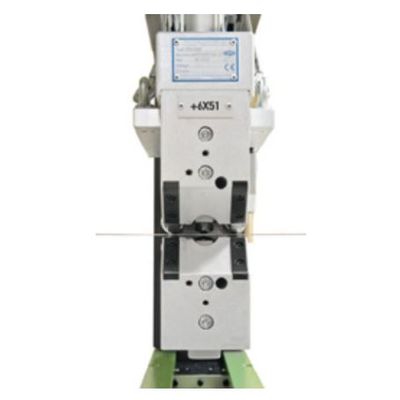
VOLLMER - Contact Thickness Gauges
The contact gauges that measure the thickness of the strip with an accuracy of a few micrometers are renowned for their outstanding precision and exceptional reliability: Almost 2000 systems that have gone into operation worldwide in recent decades are still in use even today. They still form an integral part of the measurement technology in new plants where the highest precision is demanded.
Contact gauge VBM
Flexible from 0.01 to 24 mm
Tactile (contact) measurement is employed at all stages of the strip production process – on the annealing line and during rolling, on the finishing line or during strip processing as well as in the steel service centre. Vollmer delivers the systems in different versions for thicknesses from 0.01 to 24 mm.
Precise even on wavy strip
With a measuring precision of down to one micrometre per millimetre of strip thickness, they meet the demands of modern rolling mills. Contact gauges adapt to the strip passage and follow any waviness of the material. They thus compensate angular errors by actively adjusting the sensors perpendicularly to the wavy strip material.
Contact gauge VBM
Precise even on wavy strip
The thickness is measured by using extremely precise transducers to calculate the distance between the two sensors which touch the upper and lower surfaces of the strip. The advantage of this method is that – as with the laser – the thickness is measured irrespective of the alloy. Material parameters do not have to be entered and updated.
Automatic zeroing
Vollmer uses crowned measuring sensors made from natural diamond, one of the hardest materials employed in industrial applications. When the gauge is in its parking position during changing of the coils, the sensors touch one another and the system performs automatic zeroing.
In which scenarios can we encounter contact Gauges?
Contact gauges are used in various industries and applications where precise measurements and inspections of dimensions are required. Here are some common scenarios where contact gauges are used.
Quality Control and Inspection
Contact gauges are essential tools for quality control and inspection processes. They are used to verify the dimensional accuracy, tolerances, and surface characteristics of manufactured parts, ensuring they meet the required specifications.
Calibration and Metrology
Contact gauges are utilized in calibration processes to ensure the accuracy and reliability of measurement instruments. They serve as reference standards for verifying the performance and calibration of other measuring tools, such as micrometers, calipers, or height gauges.