


- Home
- Companies
- General Water Systems INC
- Products
- GWS Wave - Model 3.1 - Cooling Systems ...
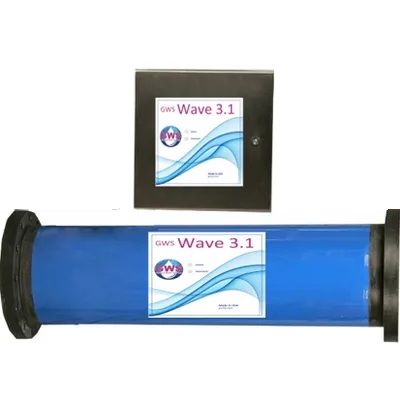
GWS Wave - Model 3.1 -Cooling Systems for Elegant Process
Cooling Systems use a significant amount of water, which requires treatment in order to prevent scale, corrosion, bacteria growth and fouling. GWS Wave 3.1 chemical-free, water treatment supports stable system operation, as these common problems are under consistent control. Additionally, since nothing replaces the human touch, routine service by competent water treatment professionals – is a key component to a smoothly operating cooling system.
- Optimal heat transfer efficiency is maintained: systems are free from scale and bio-film, manual cleanings are minimized, run-time is preserved.
- AutoSeekTM software allows for field correction if the GWS Wave 3.1 signal is compromised.
- Advanced system features such as UL approval of all sizes, NEMA 4 ratings, shop-durable construction, power efficiency, and more, contribute to long-term, cost-effective performance.
General Water Systems uses electrodynamic field generation to create uniquely effective electric fields in the flowing water of a cooling system. This digital technology far surpasses the voltage pulses created by yesterday’s circuitry. Our innovative, micro-processor-based GWS Wave 3.1 TM produces electric fields that are significantly more stable and reliable than previously created using pulsed power. GWS Wave 3.1’s induced signal:
- Creates stable electric fields that are orders of magnitude more potent than those of other technologies
- Allows for a low cost side-stream; excellent for retrofit applications
- Produces never-before-seen excellence in biological control
- Enables GWS to build a full range of sizes, 2” - 24”
Water Savings
Improving the bottom line
Both make-up and discharge water costs are dramatically reduced when GWS Wave 3.1 is engineered with GWS solids management as part of GWS' Integrated System 3.1 Higher Cycles of Concentration are routinely possible, chemical-free discharge can bypass costly sanitary sewer, and onsite reuse of discharge further enhances ROI. If these measures are put into use, dramatic operational economies are possible.
- Evaporation causes minerals in the water to reach the point of saturation, and a driving force is created.
- CaCO3 comes out of solution and forms hard limestone scale on the equipment surfaces
- The numerous suspended particles (dirt), present in the system water, would be acceptable sites for this CaC03 precipitation.
- A naturally occurring surface charge prevents the CaC03 from doing this.
- Minerals are forced to find a surface on the equipment.
- The numerous suspended particles (dirt), present in the system water, would be acceptable sites for this CaC03 precipitation.
- A naturally occurring surface charge prevents the CaC03 from doing this.
- Minerals are forced to find a surface on the equipment. Proximity - Particles closer than the equipment surface
- Relative Velocity – Particles flowing at the same rate as the CaCO3 dissolved in the water.
The alternating polarity of the fields removes the surface charge on these suspended particles, rendering them electrically neutral.
Without the surface charge, CaCO3 will plate out around the particles rather than scale on the equipment surfaces. Two reasons it does this:
- This creates a harmless, non-sticky limestone powder
- The powder particles keep growing in size over time until they reach 50-70 microns in size, and settle in the basin, or are removed by filtration (centrifugal separators are best)