


- Home
- Companies
- New Cosmos - BIE
- Products
- Cosmos - Model SH-WAD Series - Multi ...
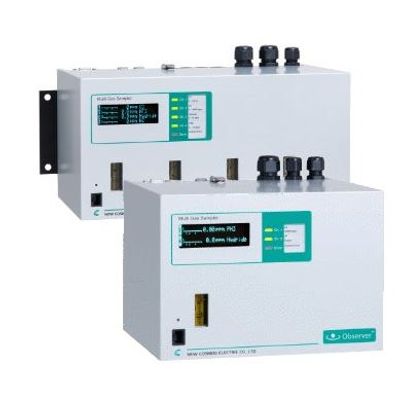
Cosmos - Model SH-WAD Series -Multi Channel Gas Detector
The SH-WAD range gas detectors have become the standard safety solutions for many production facilities and research centres. They are not only used in cleanrooms but also very useful in many other hazardous environments. The SH-WAD gas detectors can be equipped with universal plug-in modules for the provision of additional functions and communication protocols.
All units comply with the most stringent quality standards and are extremely reliable. With the integrated self diagnostics functions you are quickly notified on any possible disruption. In-Control Software will provide access to additional information about any changes in the status of the unit. By using an overall data-acquisition and monitoring system like SIMS-NX it is even possible to monitor the status of all detectors real-time. In this way there will never be a lack of clarity or information in case of an event.
There are several models in the SH-2000-WAD and SH-4000-WAD series:
- SH-2001-WAD (up to 2 sensors with 1 pump)
- SH-2002-WAD (up to 2 sensors with 2 pumps)
- SH-4001-WAD (up to 4 sensors with 1 pump)
- SH-4002-WAD (up to 4 sensors with 2 pumps)
- SH-4004-WAD (up to 4 sensors with 4 pumps)
- /CDS option: The SH-WAD series detectors can be fitted with long life time refillable sensors or with cartridge type (CDS) sensors.
Single pump units are normally used for applications where in one location multiple gases need to detected such as in tools and VMB`s
Multi pump units are normally used for applications where in multiple locations single gases need to be detected such as in gas cabinets. A SH-4004-WAD detector can monitor up to 4 single gas cabinets even if the gases in each cabinet are different.
By using the multi channel SH-WAD series significant cost reduction can be achieved because of less installation cost, but also because the multi channels detectors only use single processors and relay functions.
Maximum security and clear information
Obviously the presence of gas must be detected accurately whilst the gas sensor should be selective and preferably 100% stable! It is also important to understand that gas detection is a dynamic process - a process of gas transport and chemical and electrochemical reactions in which continuous control is essential. Managing this process requires continuous monitoring of the flow and if required the status of the pyrolyzer! Moreover, all systems permanently analyse the sensor operation.
Simple installation and configuration
Because of it’s modular construction the SH-WAD can be installed progressively.
For example, a JC-Box can be mounted during an early stage of the installation.
Configuring of the WAD units is quite simple. When installing a gas sensor, parameters such as target gas, measurement range and measurement unit are all set automatically. The user only has to specify the alarm values and the desired alarm responses. This can easily be done with the In-control™ configuration software. A laptop with this software can be connected to the RJ-45 port on the frontside of the unit.
Extensive communication possibilities
The SH-WAD unit can be used as independent detector, but can also be part of a larger gas monitoring system. Depending on the selected configuration, data transfer can take place via a bus line, but also via a 4-20mA signal. The Profibus-DP module makes it very easy to link the unit to a PLC based alarm system. Such a system
offers a great deal of flexibility and minimises installation costs.
Integrated alarm handling
In practice, alarm actions are frequently desired directly at the point of detection. Using the optional relay card, an alarm output can be made available directly inside WAD unit. In many cases this considerably reduces the amount of cabling around the system.
- In Control configuration software
Detectable gases
- Acetic Acid CH3COOH
- Acetonitrile CH3CN
- Acetylene C2H2
- Ammonia NH3
- Arsine sH3
- Benzene C6H6
- Boron Bromide BBr3
- Boron Trichloride BCl3
- Boron Trifluoride BF3
- Bromine Br2
- Butadiene C4H6
- Carbon Dioxide CO2
- Carbon Monoxide CO
- Chlorine Cl2
- Chlorine Trifluoride ClF3
- Diborane B2H6
- Dichlorosilane (DCS) SiH2Cl2
- Digermane Ge2H6
- Dimethylamine (DMA) C2H7N
- Disilane Si2H6
- Ethanol (Anhydrous) C2H5OH
- Ethylene C2H4
- Ethylenediamine C2H8N2
- Fluorine F2
- Formaldehyde HCHO
- General Acid Gen.Acid
- Germane GeH4
- Hydride Hydride
- Hydrogen H2
- Hydrogen Bromide HBr
- Hydrogen Chloride HCl
- Hydrogen Cyanide HCN
- Hydrogen Fluoride HF
- Hydrogen Selenide H2Se
- Hydrogen Sulfide H2S
- Iodine I2
- Isopropyl Alcohol IPA
- LTO520 LTO520
- Methane CH4
- Methanol CH3OH
- Nitric Acid HNO3
- Nitric Oxide NO
- Nitrogen Dioxide NO2
- Nitrogen trifluoride NF3
- N-Methylpyrrolidone NMP
- Oxygen O2
- Ozone O3
- Phosgene COCl2
- Phosphine PH3
- Phosphorus Oxychloride POCl3
- Propane C3H8
- Propylene C3H6
- Silane SiH4
- Sulfur Dioxide SO2
- Sulfur Hexafluoride SF6
- Tetrachlorosilane SiCl4
- Tetraethyl Silicate TEOS
- Trichlorosilane SiHCl3
- Trimethyl Borate (TMB) C3H9O3B
- Trimethylsilane C3H10Si
- VCM C2H3Cl
- Volatile Organic Compounds VOC