


- Home
- Companies
- Hebei Feiyu Cooling Equipment Co., Ltd.
- Products
- Counter Flow Cooling Tower with ...
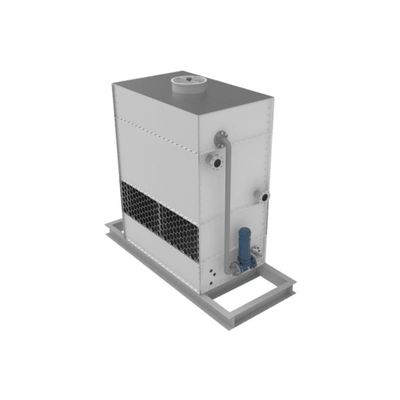
Counter Flow Cooling Tower with Opposite Spray Water & Air Inlet Flows
Counter flow cooling tower is a cooling device that is designed to remove the heat of the process fluid, thereby cooling the process fluid. With coil exchangers placed in the tower, the whole cooling process is achieved through heat change among the air, spray water & circulating water via coil exchanger inside.
In the counter flow closed circuit cooling tower, the air is introduced at the bottom of the tower and flows from bottom to top, in the opposite direction of spray water, therefore, it is named as counter flow cooling tower. It is widely used in industrial refrigeration, commercial air conditioning, process processing, district cooling, power industry, etc.
Fan is a mechanical device that is used to increase the air pressure in the cooling tower and discharge the air out. There are two types of fans for counter flow closed circuit cooling tower. One is forced draft fan and the other is induced-draft axial fan. Closed circuit cooling tower with a low height generally adopts a forced shaft fan and is suitable for indoor installation and air duct installation. It is your ideal choice for precise replacement projects.
- Compact structure, small floor area, super small model is available.
- The coil has a large heat transfer area, realizing high efficiency and water saving.
- No packing design, suitable for high temperature fluid cooling and antifreeze in winter.
- Reliable, easy operation, low maintenance cost and low annual operating costs.
- Wide range of heat rejection
- Heat rejection capacity of cooling towers with a forced shaft fan: 170-4119 MBH
- Heat rejection capacity of cooling towers with an induced-draft axial fan: 91–37765 MBH.
- Customized solutions, tailored for your projects, bringing you more reasonable suggestions and assurance.
Hot process fluid enters the coil (or tube bundle) from the water intake, and the spray system and fan system are started at the same time. The heat of process fluid undertakes heat transfer via tube walls and is transferred to the spray water running through the outer surface of the tube. The process water becomes cool and then flows out from the water outlet for internal circuit. Driven by the fan, the air outside the unit enters from the air intake, in the opposite direction of water flow, and moves upward through the coil. A small amount of water evaporates and flows through the drift eliminator, collecting the excess moisture into the water tank. Meanwhile, the hot and humid air is dispatched into the atmosphere from the top of the tower. The rest of the water falls into the water tank at the bottom, recycles to the spray system via the water pump, and then returns to the tube bundle.