- Home
- Companies
- CPS Instruments Inc.
- Products
- CPS Instruments - Disc Centrifuge ...
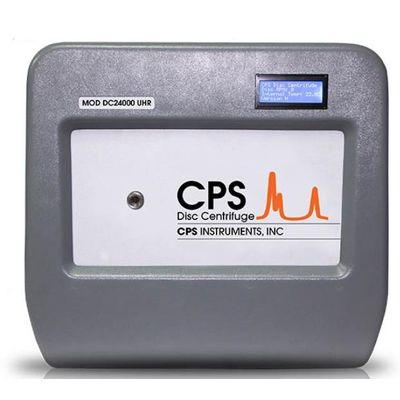
CPS Instruments - Disc Centrifuge Particle Size Analyzer
The CPS disc centrifuge separates particles by size using centrifugal sedimentation in a liquid medium. The sedimentation is stabilized by a slight density gradient within the liquid. The particles sediment through the density gradient inside a transparent rotating disc, through which a light beam passes. As particles move towards the outer edge of the disc, they pass through the light beam, attenuating the beam intensity. Detector beam attenuation is continuously recorded and converted by the operating software into the weight of particles at each size in the sample.
Speed
- Measures samples 3 to 4 times faster than competitive centrifuge-based instruments.
- Detector and electronics operate with an effective response time of ~0.1 second compared to ~1 second for competitive disc centrifuges.
- For a majority of applications, analysis times are in the range of 3 to 15 minutes/sample.
Resolution
- Completely separates narrow peaks that differ by as little as 2%.
- Partially separates narrow peaks that differ by as as little as 1.5%.
- Reported distributions contain virtually no distortion/contribution from the instrument.
- No other particle sizing instrument can match the CPS Instruments disc centrifuge in high resolution performance.
Accuracy
- All analyses are run against a known calibration standard.
- Typical precision of reported sizes with external standard is ± 0.5% (95% confidence).
- Typical precision of reported sizes with internal standard is better than ± 0.25%.
- Replicate runs produce virtually duplicate results in all cases.
CPS Instruments` Disc Centrifuge isn`t merely the fastest and most accurate high resolution particle analyzer on the market. Its intuitive software, graphical interface, and thoughtful design make it one of the easiest to operate as well.
01. INITIAL CONSULTATION
During your initial consultation, a specialist from CPS Instruments gathers information about your operation and specific particle size measurement needs.
02. ON-SITE DEMO
Once you`re confident of the CPS Instruments advantage, an on-site demo can be scheduled so that you can experience our state-of-the-art disc centrifuge first-hand.
03. SAMPLE ANALYSIS
To demonstrate the superior value of our disc centrifuge, we perform a sample analysis, delivering the industry`s highest resolution results for your review.
04. INSTALLATION TRAINING
Your equipment is shipped, and a knowledgeable consultant ensures proper installation and functioning while providing a day-long training on the technology.
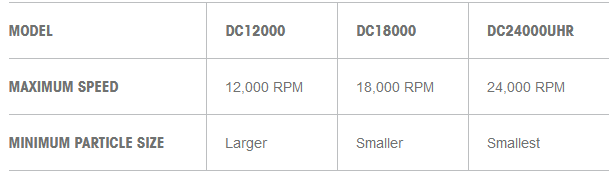
The size range capability of CPS Instruments` disc centrifuge is dependent on the density of the particles to be measured as well as the difference in density between the particles and the fluid.
The upper size capability for nearly all samples is approximately 50 microns. The lower size limit depends on the density of the particles. The higher the density of the particles, the smaller the lower size limit will be.
For example, gold sols (19 g/mL) can be measured to as small as ~3nm, ceria (7.2 g/mL) can be measured to ~8nm, and polystyrene (1.052 g/mL) can be measured to ~35nm.
Using fixed centrifuge speed, the largest practical ratio of sizes in a single analysis is about 70. If the largest particle to be measured is 3 microns, particles as small as 0.04 micron can normally be measured in a single analysis of less than 1 hour.
Using ramping of speed during the analysis, the practical dynamic range is up to 1000 or more. If the largest particle to be measured is 30 microns, particles as small as 0.03 micron can normally be measured in a single run.