


- Home
- Companies
- Cristal - Foss S.r.l.
- Products
- Cristal Foss - Reverse Osmosis Systems
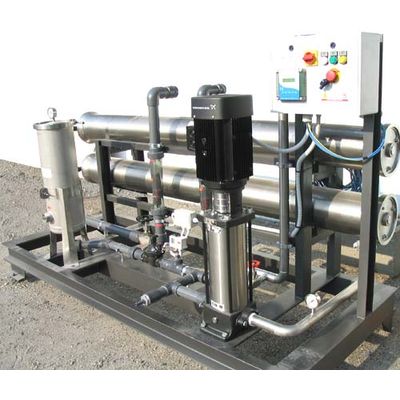
Cristal Foss - Reverse Osmosis Systems
The CFROL is a line of commercial water purification systems designed to utilize the latest in low energy new membrane technology by using the highest production commercial membranes available. Reverse osmosis systems are available as either `stand alone` or `turnkey` units ranging in fresh water production capacity from 50lt/h to 50,000 lt/h and up for drinking plant, bottling, water stores or other commercial or industrial needs where good water purity is required.
Commercial and industrial reverse osmosis systems can generally produce water in the 2 to 10 mg/liter, numerically equivalent to parts per million (PPM) TDS range, assuming incoming water TDS are under 1000 mg/liter.
Water quality may vary depending on a variety of conditions, mainly membrane condition. Production rates may vary depending on temperature, pressure, membrane condition and other factors such as the amount of water "recycled" within the reverse osmosis system as part of the filtration process, in any case the performance as guaranted from membrane suppliers.
- The line systems feature stainless steel membrane vessels side port type, low energy TFC membranes, and front panel mounted flow meters, coustomized electronic device at low voltage, stainless steel prefilter housing, pressure gauges and a low inlet pressure switch.
- The pressurizzazion of membrane as applied by multimpellers vertical pumps made in stainless steel. The skid is made in iron epoxy painted, the HP piping and components are made in stainless steel.
- The LP piping and components are made in PVC. For additional information request technical book CFROL Series by writing to CRISTAL-FOSS.
Reverse Osmosis (RO) is a process technology used membrane in which solutions are desalted or concentrated using relatively high hydraulic pressure as the driving force.
The principle of osmosis is quite simply those two different fluids, one with low salt content, separated by a semipermeable membrane, always will try to equalize the salt percentage to the high salt content fluid. If a semipermeable membrane separates the two fluids, the fluid with the low salt content will permeate the membrane (H2O) until the salt content is the same at both sides of the membrane. The level difference of the two fluids is called the osmotic pressure.
In the Ro process the salt ions and other contaminates are excluded or rejected by the RO membrane while pure water is forced through the membrane by pressure.
The principle of reverse osmosis is that the saline raw water is led across a membrane. Through the microscopic pores in the surface of the membrane, only H2O the pure water molecules that will pass since the water molecule is one of the smallest molecules in liquid form. The microscopic pores of the osmosis membranes are adapted to the water molecule and consequently do not let pollution like e.g. heavy metals, chemicals, virus and bacteria slip through since all these matters are larger than a water molecule.
Before the raw water is led into a reverse osmosis plant, it might be necessary to mechanically filter off larger particles first in order to avoid clogging of the membranes. It may also be appropriate to soften the raw water in a softening filter to avoid lime deposits from lodging and thus blocking membranes.
Reverse Osmosis (RO) is a filtration technique where you add pressure to the fluid with the highest salt concentration and then press this fluid through a RO membrane casing a very fine membrane that can reject filter both ions and dissolved matters in the water. Not all ions can be retained 100 %. A certain amount 1-2% will penetrate the membrane; this depends on the size of the molecule as well as the membrane. If a very low residual concentration of ions is desired; it may be necessary to employ multiple Ro plants in series or combined with other technologies mixed bed.
In a reverse osmosis system used for treatment of seawater, brackish and tap water. The seawater can be retrieved direct from the sea either through a preliminary filter, or preferably from a borehole on the beach. The borehole is no more than 10 to 15 m deep, but the large quantity of sand that the seawater must pass through on its way down to the bottom of the borehole provides excellent preliminary filtration.
Before the seawater reaches the reverse osmosis system. Like brackish water, it must be pretreated. Pre-treatment of seawater is generally more complicated than pre-treatment of brackish water, where the raw water typically comes from deep boreholes with the consequent better natural preliminary filtration.
It is the osmosis principle that makes water pass up through plants and reach the outer leaves, whereas the membrane will retain non-dissolved matters. The higher you reach up into the plant, the more salts the sap contains and consequently water will seep in through the roots of the plant and press through all the plant cells to the outermost ends.
Membranes to be used in industrial plants are often made of polyamide or polysulphone that can work in the ph range 2-12. The filtered fluid is called the permeate, whereas the retained, concentrated fluid is called the concentrate.
All impurities will be rejected, but oxygen (O2) and CO2 that is a gas and smaller than the water molecule, will slip through the osmosis membrane meaning that the natural oxygen of the water is preserved.
In a reverse osmosis plant only a certain percentage of the inlet, water is utilized, normally between 60 and 80 %, if the plant is equipped with pre-treatment, and between 40 and 50 % without pre-treatment – the rest is discharged as concentrate. The permeate – the clean water – will often be collected in reservoirs, so that the RO plant can run.
Continuously, but the water can be collected from the reservoir when required.
Ro water contains an amount of carbon dioxide molecules as these molecules are smaller than the H2O molecules and therefore will always penetrate the membrane. However, by evaporation of 1 m3 Ro water the residual content will be approx. 5-15 g.