

- Home
- Companies
- Testex Textile Testing Instruments
- Products
- Testex - Model TF117C - Crumple Flex ...
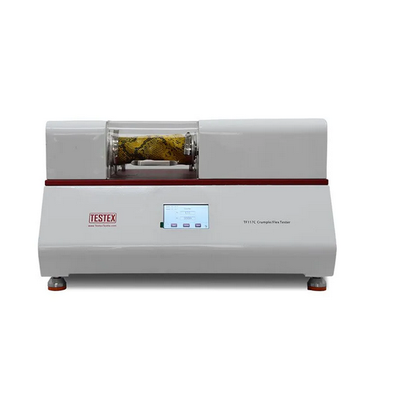
Testex - Model TF117C -Crumple Flex Tester
Crumple Flex Tester is widely applicable to determine the degradation of water resistance of coated fabrics due to crumpling and Flexing in use. As we can see, it is necessary to test fabrics in terms of their ability to withstand repeated flexing without creating crackings. One of the machines available and used in such a test is the TESTEX Flex Cracking Tester. Crumple Flex Tester TF117C is a testing instrument with excellent equipment and a stable operation system at a reasonable price.
Crumple Flex Tester, by using this instrument, the users can test the degradation of water resistance of coated textiles due to flexing and crumpling in daily application use, which contributes to improving the water resistance of the fabric performance for the manufacturers.
The equipment tests a tube of fabric by twisting it through 90° stretching and alternately compressing the tube at the same time. After the flexure test, immediately, it can test the water penetration resistance of the fabric according to ISO 1420. A pre-set electronic counter automatically stops the crumple flex tester when the test reaches a preset cycle. In all, Crumple Flex Tester measures the waterproof resistance of fabrics by simulating the repeated flexing of a garment during use. Besides, Crumple Flex Tester TF117C is a testing instrument with excellent equipment and a stable operating system at a reasonable price.
- Work stations 2
- Impact design of construction and appearance
- Acrylic safety cover ensures safety in operation
Sew a rectangular piece of coated fabric test sample into a cylindrical shape and mounted it between two discs. One of the discs oscillated approximately 90° on its axis. As a result, the cylinder of the coated fabric test piece will twist. At the same time, the other disc moves reciprocally along its axis, thus causing the cylindrical sample to be compressed along its length. This twisting and compression of the cylindrical test specimen continue for a predetermined number of cycles, or until the test piece appears visibly damaged.