

- Home
- Companies
- Nanjing Hjchem Equipment Co.,Ltd
- Products
- Hjchem - Custom SPPS Synthesis Reactor ...
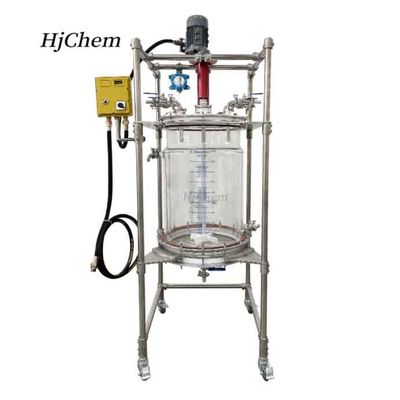
Hjchem - Custom SPPS Synthesis Reactor 1L-100L
SPPS reactor is a kind of glass nutsche filter reactor designed to the repetitive chemical reactions required in solid-phase peptide synthesis. It combines precise control of reaction conditions with efficient mixing and washing of solid phase (resin) to produce peptides.1. Volume: 1L, 2L, 3L, 5L, 10L, 20L, 30L, 50L, 100L, for the small laboratory research scale to pilot plant kilo-lab scale.
2. Vessel: Single wall, double wall or triple wall available
3. Working pressure: Full vacuum to 0.05/0.1Mpa
4. Working temperature: -80°C ~ +220°C
5. Wetted parts: Borosilicate glass 3.3, PTFE
6. Filter device: PTFE, glass or stainless-steel, pore size 0.1um to 200um
Solid-phase synthesis is a common technique for peptide synthesis. Usually, peptides are synthesised from the carbonyl group side (C-terminus) to amino group side (N-terminus) of the amino acid chain in the SPPS method, although peptides are biologically synthesised in the opposite direction in cells. In peptide synthesis, an amino-protected amino acid is bound to a solid phase material or resin (most commonly, low cross-linked polystyrene beads), forming a covalent bond between the carbonyl group and the resin, most often an amido or an ester bond. Then the amino group is deprotected and reacted with the carbonyl group of the next N-protected amino acid. The solid phase now bears a dipeptide. This cycle is repeated to form the desired peptide chain. After all reactions are complete, the synthesised peptide is cleaved from the bead.
The protecting groups for the amino groups mostly used in the peptide synthesis are 9-fluorenylmethyloxycarbonyl group (Fmoc) and t-butyloxycarbonyl (Boc). A number of amino acids bear functional groups in the side chain which must be protected specifically from reacting with the incoming N-protected amino acids. In contrast to Boc and Fmoc groups, these have to be stable over the course of peptide synthesis although they are also removed during the final deprotection of peptides.
1. Reaction Vessel and Solid Support Handling
Function: holds the resin (solid support) on which the peptide is synthesized. The mixing vessel is designed to allow efficient mixing and interaction of the resin with the reagents.
Benefits: provides a stable environment for the peptide synthesis, ensuring uniform exposure of the resin to the reagents.
2. Mixing and Agitation
Function: make the mixing of resin and reagents thoroughly and promote efficient coupling reactions and deprotection steps. Mixing is achieved through mechanical stirring.
Benefits: enhances the contact of the resin and reagents, leading to efficient reaction.
3. Temperature Control
Function: control reaction temperature for various stages of the synthesis process, including coupling and deprotection reactions.
Benefits: precise temperature control can accelerate reaction rates and improve the efficiency of solid-phase synthesis, especially for temperature-sensitive reactions.
4. Filtration and Washing
Function: after each coupling and deprotection step, the reactor washes the resin to remove unreacted reagents, by-products and solvents. Filtration is used to separate the liquid phase from the solid resin.
Benefits: make sure each reaction step proceeds with minimal contamination, improving the final peptide purity.
For more information, please visit us:
https://njhjchem.com/product/glass-nutsche-filters/custom-spps-synthesis-reactor-1l-100l/