


- Home
- Companies
- JetmillMFG
- Products
- JetmillMFG - Cyclone Separator: ...
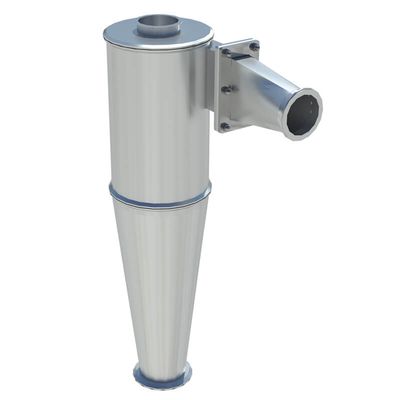
JetmillMFG - Cyclone Separator: Industrial Air and Particle Separation Device
A cyclone separator is a dry gas-solid separation device that separates particles from the air or gas stream, without the use of filters. Cyclone separators play a critical role in various industrial processes because of their simple structure, small footprint, convenient operation and maintenance, and high separation efficiency.
The basic structure of a cyclone separator typically consists of a cylindrical body, a conical section, an inlet pipe, a collection chamber, an airlock and an outlet. Our cyclones separators are used in grinding and classifying equipment for separating products from air streams.
The gas steam enters the cyclone through the inlet pipe at a high speed along the tangential direction of the cylindrical body and starts to rotate. During the rotation, the gas steam generates a significant centrifugal force. Due to the larger inertia of the particles compared to air, most of the particles are thrown towards the inner wall of the cyclone. The particles lose their inertia and fall along the wall, entering the collection chamber. The collected particles are discharged through the rotary valve.
The descending rotating air steam, upon reaching the bottom of the cone, forms a rising inner swirling steam and is exhausted through the central outlet at the top. Most cyclone separators are generally built to control particles larger than 5-15μm in diameter.
- Simple construction with no moving parts
- High efficiency in removing solid particles from gas streams
- Typically compact in size and do not require a large footprint
- Low maintenance requirements, reducing downtime and maintenance costs
- Minimal energy input for particle separation
- Low investment compared to other separation equipment