

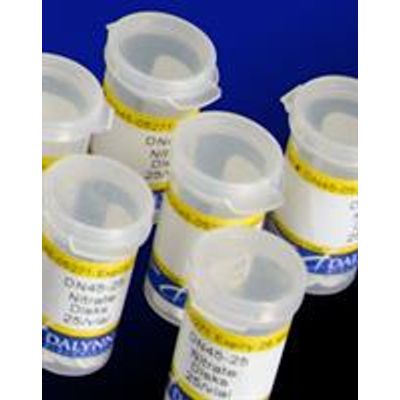
Dalynn - Model DD10-25 -Microbiology Disks
Our 0129 Disks are used for the differentiation of vibrios from other gram-negative bacteria. Shewan and Hodgkiss recognized the sensitivity of vibrios to the vibrio-static agent 0129 (2,4-diamino-6.7-di-isopropyl-pteridine phosphate) in 1954. 0129 was found to be useful in the differentiation of vibrios from other gram-negative bacteria especially aeromonads. which are characteristically resistant to 0129. Among the genera, different species of vibrios show different sensitivities to 0129; this can be used as a diagnostic feature as antimicrobial disks of different concentrations can be used to determine their degree of sensitivity.
0129 disks are offered at two concentrations: 10-pg and 150-pg. Methods for standardized disk antimicrobial susceptibility testing are employed, with any zone of inhibition around 0129 disks being regarded as sensitive. Salt containing media (0.5%) must be used for the testing procedure, as sodium ions stimulate the growth of all Vibrio species and are required by most.
Recommended Procedure
- Obtain a pure, fresh culture of the test organism.
- Using a sterile swab, streak a sample of the organism onto a non-selective Blood Agar Plate (containing 0.5% NaCl) in three directions to obtain a heavy, confluent growth.
- Aseptically place one 10pg and 150pg 0129 Disk onto the agar surface. Ensure that the disks are situated suitably apart from each other to avoid meeting of zones.
- Incubate aerobically at 35°C for 24 hours.
- Observe for zones of inhibition.