

- Home
- Companies
- Darda GmbH
- Products
- Darda - Model C4S - Splitters
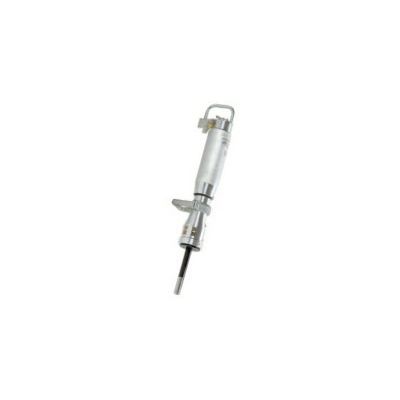
Darda - Model C4S -Splitters
Small and compact. Demolition in tight places (e. g. tunnel and Underground mining).
Advantages
Economical
Blasting usually requires work stoppages and the installation of protective walls and other safety equipment. This costs both time and money. With DARDA high-performance rock and concrete splitters, blasting is not longer necessary. Therefore, [there is no potential danger to the workforce or passers-by, and other work in th immediate surroundings can continue unaffected.
Safe
Hydraulic splitting means controlled demolition. The entire force developed is always under full control. There is no danger of flying debris, vibrations or even explosions.
Environmental-friendly
When using the DARDA hydraulic splitting technique, there are unpleasant side effects like vibrations and dust. Even noise emission is extremely low, which means that, all in all, this demolition technique is particularly environmental-friendly. That is why the DARDA splitter is indispansable in densely populated areas or inside buildings.
Durable
Thanks to the extremely robust design, the DARDA rock and concrete splitter can withstand even the toughest conditions. Its durability is quite exceptional. Therefore, next to no maintenance is required. Yet another cost-saving factor.
Autonomy
DARDA splitters and pump units are easy to transport. Operators no longer depend on heavy machinery, e.g. excavators, for their transport to the demolition site. Therefore, even the smallest workplace is no longer a poblem.
Easy to use
The splitters are extremely easy to operate. The lightweight design enables an operator to work on a splitting job single-handedly. Even unskilled workers can learn to use the DARDA splitter in a very short time.
Controlled demolition
DARDA hydraulic rock and concrete splitters enable you to work with a precision that cannot be achieved when using conventional demolition methods. The desired direction of the split and size of material to be removed can be determined beforehand. The portion of a structure that ought to remain intact is not affected by the splitting process.
Technical Details
A complete DARDA rock and concrete splitter compromises 3 components:
- one or several splitting cylinders
- one hydraulic pump unit
- one set of high- and low-pressure hoses
Hydraulic splitting cylinder
The hydraulic splitting cylinder consists of a control valve, a cylinder, a front head and a wedge set (1 wedge and 2 counter wedges). The entire cylinder is made of highest quality aluminium and steel so that although the equipment is light, it is still extremely durable. The counter wedges are also coated with a hard metal (carbide) layer in a specially developed hardening process. This makes them more resistant to very high pressure and forces.
Multitude of applications
There are different types of splitting cylinders available for a variety of applications.
Hydraulic pump unit
Electric, air, diesel or gasoline motors can be used to drive the high-pressure pump units. The system pressure has been limited to 50 MPa (500 bar) by a pressure limiting valve. Both mobile and portable pump units are available. Depending on the pump model, up to 5 splitting cyclinders can be run simultaneously.
Hydraulic hoses
High- and low pressure hoses connect the splitter to the pump unit. If several splitters are to be connected, a distributor part is attached to the end of the 1 0 m hose.
Enlarging counter wedges
If you need to enlarge the crack already made, simply remove the counter wedges initially used and replace with enlarging counter wedges. The crack can now be widened further, allowing heavy duty iron bars and other reinforcements to be cut.
Pressure shells
In a small diameter drill hole, the high splitting force acts on a very small area, exerting extreme surface pressure. In the case of heavily steel- reinforced concrete and under the most unfavorable conditions, attempts at splitting may merely compact the concrete, leaving an oval hole. Only short cracks develop around the hole and the reinforcing rods remain unaffected. In such cases, two large, heavy-gauge pressure shells provide the necessary remedy. These are introduced into a 1 00 mm diameter core hole and enclose the wedge set of the splitting cylinder. The splitting force is now applied over a large area, resulting in a precise split and forcing the steel rods apart more effectively.
Special lubricant
During the splitting process the wedge set is exposed to extremely high forces. This requires that the inner wedge and counter wedge surfaces be frequently lubricated. Tests carried out over an extended period of time proved beyond doubt that only our special lubricant is capable of significantly reducing the extreme friction. Owing to that, the use of DARDA lubricating paste guarantees the highest splitting performance which is 20 to 50% higher than if conventional lubricants are used.