


- Home
- Companies
- Wyatt Technology Corporation (WTC)
- Products
- DAWN - Multi-Angle Light Scattering ...
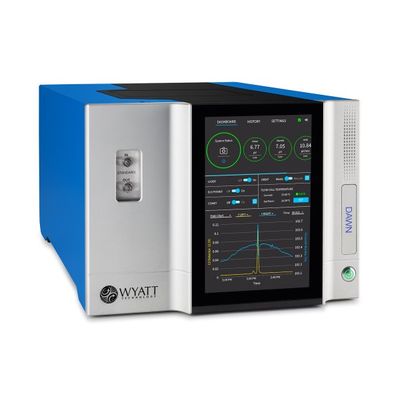
DAWN - Multi-Angle Light Scattering (MALS)
The world`s most advanced light scattering instrument for absolute characterization of proteins, conjugates, macromolecules, and nanoparticles.
Premier MALS
The DAWN® is the premier Multi-Angle static Light Scattering (MALS) detector for absolute characterization of the molar mass and size of macromolecules and nanoparticles in solution. The DAWN offers the highest sensitivity, the widest range of molecular weight, size and concentration, and the largest selection of configurations and optional modules for enhanced capabilities.
Used with SEC-MALS
The DAWN is most often used in conjunction with Gel Permeation Chromatography (GPC-MALS) or Size Exclusion Chromatography (SEC-MALS) or Field-Flow Fractionation (FFF-MALS) to determine distributions of mass, size and composition independent of column calibration by reference standards.
Compatible with ASTRA®
The DAWN is accompanied by ASTRA, the most versatile software package available for analysis of online multi-angle and dynamic light scattering.
The DAWN and its companion Optilab® dRI detector are the established benchmarks for MALS analysis, cited in thousands of peer-reviewed publications. Multi-angle light scattering detection is indispensable for use with GPC and HPLC-SEC in order to obtain reliable molecular mass distributions and information on molecular conformation, branching ratio, fragments and aggregates.
SEC-MALS with a DAWN and Optilab characterizes conformation and branching of synthetic and natural polymers larger than 10 nm in rms radius Rg. The addition of a ViscoStar® differential viscometer creates a GPC triple-detection system that can analyze molecular conformation and size below the Rg limit of 10 nm and determine Mark-Houwink Sakurada coefficients.
The combination of a UV/Vis absorbance detector with a DAWN and Optilab refractive index detector creates a UV-MALS-RI triple-detection system, for analysis of copolymers and protein conjugates (glycoproteins, PEGylated proteins, surfactant-bound membrane proteins, etc.). With the addition of a WyattQELS™ DLS module for size determination, protein conformation may be analyzed.
- Mw from 200 Da to 1000 MDa
- Sensitivity: 10 ng/mL 100 kDa polystyrene in THF, 0.4 µg/mL BSA (66.4 kDa) in PBS
- Rg from 10 to 500 nm, up to 1000 nm with shape-specific models
- Ultra-stable, high-power laser
The DAWN may also be used in batch (off-line) mode to characterize the weight-average molar mass, z-average size and second virial coefficient of unfractionated samples.
In conjunction with a Calypso® CG-MALS system, the DAWN characterizes macromolecular interactions, label-free and immobilization-free: affinity and absolute stoichiometry of self- and hetero-association of simple or complex molecular systems. The Calypso system also automates the determination of second virial coefficients, cross virial coefficients, average molar masses and sizes.
Ultrasonic Cleaning Included
Each DAWN includes an embedded COMET™ ultrasonic transducer that cleans the flow cell automatically by agitating the fluid and loosening particles from the glass surfaces.
Temperature-Controlled Models
- Ambient model
- Ultra-High-Temperature (UHT) model, from ambient up to +210 °C
- Standard Peltier heated/cooled (H/C) model, temperature control from -15 °C to +150 °C
WyattQELS - A dynamic light scattering (DLS) detection module which integrates inside the DAWN to provide simultaneous DLS measurements in the same scattering volume. The optical collection fiber replaces a MALS detector at any of the 18 detection angles.
DynaPro NanoStar - Primarily used for batch DLS, the NanoStar does double duty as an on-line DLS detector by installing its optical collection fiber into any of the 18 MALS detectors in the DAWN.
Ultrasonic Cleaning
COMET - An ultrasonic transducer that cleans MALS flow cells automatically by agitating the fluid and loosening particles from the glass surfaces. Integrates inside the DAWN.
Laser Wavelength
The standard 658 nm red laser may be replaced in the factory with an infrared laser operating at 785 nm. The IR laser minimizes or prevents sample fluorescence to ensure correct molar mass and size measurements on samples that fluoresce under 658 nm excitation. Please Contact Wyatt for available laser wavelengths. Narrow bandpass fluorescence-blocking filters are also available.
Optical Filters
Optional polarization or fluorescence-blocking filters may be installed in the DAWN. Fluorescence-blocking filters improve greatly the analysis of samples that fluoresce upon irradiation at the laser wavelength.
-
The DAWN may be positioned downstream of all types of standard GPC, HPLC or FPLC systems for analysis of molar mass and sizedistributions (see SEC-MALS), and derivatives such as conjugation and conformation analyses, all included in the ASTRA data collection and analysis software. For those systems equipped with a UV, RI, fluorescence or other concentration detector, the DAWN accepts up to 4 analog inputs so a 3rd-party concentration signal may be used in MALS calculations of molar mass. The DAWN is generally set up downstream of a UV detector and upstream of a RI detector.
In most cases it is beneficial to connect an Optilab T-rEX RI detector to the eluent stream. This permits universal concentration detectionregardless of fluorophores or chromaphores. The combination of UV and RI signals, acquired simultaneously, is utilized in ASTRA`sConjugation Analysis algorithm to characterize binary complexes such as glycoproteins, PEGylated proteins, or block co-polymers.
The DAWN may also be connected to an Eclipse FFF system for characterization of macromolecules and nanoparticles from 1 nm to 1 µm via FFF-MALS.
Both SEC-MALS and FFF-MALS will benefit from an additional WyattQELS module for measuring nanoparticle size via dynamic light scattering (DLS). The WyattQELS utilizes the same laser and flow cell volume as MALS detection. Its collection fiber replaces any one of the 18 MALS detectors in the DAWN.
For analysis of natural and synthetic polymers, the ViscoStar II may also be added as well. Differential viscometry is an orthogonal means of determining molar mass and conformation.
-
MALS detectors may be operated in batch mode when the analysis does not benefit from separation:
- If the sample is not amenable to separation by SEC or FFF (e.g., very large and diffuse polymers such as PMMA) to measure weight-average molar mass, and size as z-average radius
- In order to validate SEC-MALS measurements:
- to determine if large aggregates or other species are filtered out on the column
- to determine if reversible aggregates dissociate subsequent to dilution on the column or separation channel
- In order to characterize macromolecular or nanoparticle complexes which are disrupted by column shear or dilution
- In order to measure binding affinity or reaction kinetics of macromolecules such as protein-ligand interactions
Calypso II - Automated sample preparation and delivery system for carrying out and analyzing composition-gradient MALS in a DAWN. Analyses include biomolecular interactions, high-concentration protein-protein interactions, Zimm plots and dn/dc as well as time-resolved MALS. Utilizes the CALYPSO software for interaction analysis.
microCUVETTE - Allows static and dynamic light scattering measurements to be made simultaneously in a MALS detector using a quartz cuvette, requiring only 10 µL.
NanoFilter Kit - Makes it easy to filter, recover and refilter precious sample. This is especially useful when your total sample volumes are below 300 µL.
Microbatch Kit - Used to inject samples into the flow cell of a MALS detector, and in determining dn/dc with an RI detector.
Batch Conversion Kit - Inexpensive scintillation vials often suffice when sample volumes aren`t an issue, especially if the sample may congeal in the MALS flow cell.
Measurements:
- Molar Mass Range: 200 Da to 1000 MDa *
- Molecular Size Range (rg): ≈ 10 to 500 nm, up to 1000 nm with shape-specific models *
- Molecular Size Range (Rh,
- with WyattQELS DLS module or
- DynaPro NanoStar): Depends on the scattering angle:
- In flow mode, 0.5 nm – 300 nm†*
- batch mode, 0.5 nm – 1 µm *
- Sensitivity: 10 ng of 100 kD polystyrene in THF*
Fluidics:
- Mobile Phase Compatibility: All-solvent compatible (aqueous and organic). Wetted materials are 316 stainless steel, fused silica or F2 glass, and Kalrez.
Optics:
Detectors:
- MALS Detectors: High-gain, high dynamic range, static light scattering detectors at 18 angles.
- Auxiliary Detectors: Laser monitor for stabilization feedback; forward transmission monitor to correct signals for absorbing samples and to assess data quality.
- A/D Resolution: 24 bit (detector dynamic range > 16,000,000)
- DLS Detector (optional): WyattQELS dynamic light scattering module installs directly inside the DAWN chassis.
- Alternatively, the optical fiber pickup of the DynaPro NanoStar cuvette-based DLS instrument may be installed in the DAWN.
- Laser Properties:
- Laser Wavelength: 658 nm; 785 nm available for fluorescence reduction (with lower sensitivity than 658 nm)
- Laser Power Control: Programmable 10% - 100%
- Flow Cells: Fused Silica, optimal for solvent refractive index less than 1.50
- F2, optimal for solvent refractive index above 1.50
- Temperature Options:
- Ambient
- Heated/Cooled (HC) -15°C to +150°C
- Ultra-High-Temperature (UHT) ambient to +210°C
Electronics:
- Analog Inputs: 4 differential analog inputs with 24 bit resolution. Input range -10 V to +10 V
- Analog Outputs: 2 analog outputs from user settable measurements channels -10 V to +10 V
- Other Inputs/Outputs: Alarm in, Alarm retransmit, Auto-Inject in, Auto inject contact closure, Recycle in, Recycle valve power
- Computer Interface : Ethernet
- Transmission Rate: 36.6 to 0.0001 Hz
- Front Panel Display: 162.5 mm, 16-bit, high resolution touch screen displays signal graphs, instrument settings and diagnostics
- Dimensions: 60 cm (L) x 36 cm (W) x 23 cm (H)
* depending on dn/dc, the sample concentration, and chromatography conditions, this is typical.
assuming a flow rate of 0.3 mL/min and DLS detection at 160°.