


- Home
- Companies
- Sequoia Scientific, Inc.
- Products
- Sequoia Scientific - Model LISST-Deep - ...
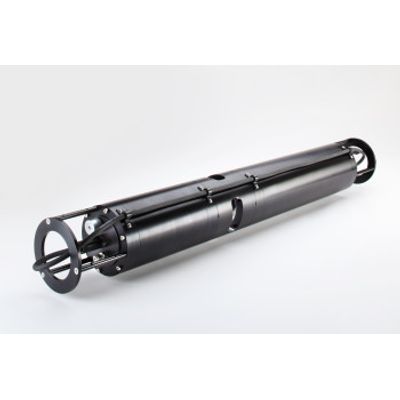
Sequoia Scientific - Model LISST-Deep -Deep Submersible Particle Size Analyzer
The LISST-Deep instrument obtains in-situ measurements of particle size distribution, optical transmission, and the optical volume scattering function(VSF) at depths down to 3,000 meters. The LISST-Deep extends operating depth range beyond the LISST-100X or LISST-200X instruments allowing measurements of particle size to be made with at 1 hz with minimal disturbance to the particles.
- 4,000 meter depth rating (prior to 2020, rating was 3,000)
- Small angle forward scattering laser diffraction technology
- Measures particle size, concentration, beam attenuation, VSF, depth, temperature
- Self contained with internal programmable datalogger for autonomous data collection
- Externally powered
- Optional external battery pack, rated to 4,000 m depth
- USB connection to PC for programming, offloading and real-time size distribution displays
- Integrated depth and temperature sensor
- Power and integrate up to three external analog sensors
- 36 size classes
- Analog output of mean particle size and total volume concentration for CTD integration
- Real-time output of complete Particle Size Distribution
Using a red 670nm diode laser and a custom silicon detector, small-angle scattering from suspended particles is sensed at 32 specific log-spaced angle ranges. This primary measurement is post-processed to obtain sediment size distribution, volume concentration, optical transmission, and VSF. The LISST-Deep is programmed and operated like a LISST-100X. The LISST-Deep can be ordered as a type B (1.25-250µm) or type C (2.5-500µm) size range.
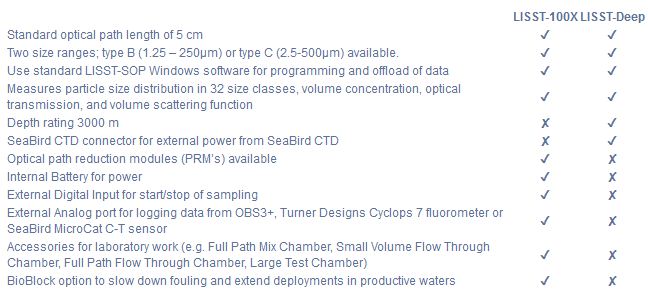
If you study the design of the LISST-Deep and compare it with the LISST-100X it is clear that the mechanical design is very different from that of the LISST-100X. The optical path is more or less in the middle of the instrument, not at the end. This means that no accessories available for the LISST-100X will work with the LISST-Deep, with the exception of communication cables and instrument stands. No BioBlock, mixing chambers or path reduction modules are available for the LISST-Deep.
Also, because of the much thicker wall of the pressure housing, there is no room for internal battery packs as for the LISST-100X. The LISST-Deep must be powered externally at all times. This is typically achieved by connecting it to a CTD, getting power from the CTD. A cable for connecting to a CTD will be included, if the customer supplies Sequoia with the pin-out of the CTD upon ordering. Upon request, Sequoia can furnish a quote for a LISST-Deep external battery pack with cable for connecting to the LISST-Deep.
The LISST-Deep and the LISST-100X was used after the Deepwater Horizon accident in April 2010 to detect oil droplets and their size in the deep waters of the Gulf of Mexico.
Parameters measured
- Particle size distribution from 1.25-250µm or 2.5-500µm
- Depth (3000 m max depth @ 0.8 m resolution)
- Optical transmission @ 0.1 % resolution
- Volume concentration @ 0.1 µl/l resolution
- Volume concentration @ 0.1 µl/l resolution
- Volume concentration @ 0.1 µl/l resolution
- Volume scattering function (VSF)
Operating concentration range
- Optical transmission from 0.3-0.985 (30-98.5%)
- Concentration range 1-800 mg/l (grain-size dependent)
Technology
- Small-angle forward scattering
- 32-ring custom photodiode ring detector for small-angle VSF
- 50 mm optical path (10 mm with optional 80% PRM)
Mechanical and electrical
- Dimensions 12.57 cm (4.95”) dia. by 80.3 cm (31.6”) L
- Weight: 17/8 kg (38/18 lbs) in air/water
- 3000 m depth rating
- External power input: 9VDC nominal, 6-24VDC
- Sampling rate: Up to 1 Hz
- 670 nm solid state diode laser
- Power drain: 145 mA / 8mA (measuring / quiescent)
- Data storage: 1 GB (~12,500,000 size distributions)