


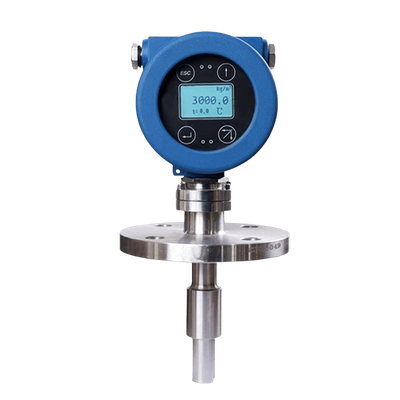
ProFlow - Model 49000 -Density Flow Meter for Accurate Fluid Measurement
A density flow meter is an advanced instrument designed to accurately measure the density of fluids in various process lines. It finds extensive application in industries such as oil and gas, chemical processing, food and beverage, and pharmaceuticals. These flow meters are integral to ensuring product quality, process stability, and compliance with industry standards by offering real-time density data. They employ various technologies like vibrating elements, Coriolis effect, gamma radiation, and changes in electrical capacitance to provide accurate density measurements. Key advantages include precise monitoring of fluid properties, detection of composition variations, and enhancements to production efficiency. Density flow meters also help determine additional fluid characteristics, such as concentration and specific gravity. However, challenges like the need for temperature compensation and sensitivity to fluid composition changes must be managed. The choice of a specific density flow meter should be based on the fluid's characteristics and the necessary accuracy.
A Density flow meter is a specialized instrument used to measure the density of a fluid as it flows through a process line. Density measurement is crucial in various industries, including oil and gas, chemical processing, food and beverage, and pharmaceuticals, as it provides essential information about the composition and quality of the fluid being transported or processed. The density of a fluid is typically expressed as the mass per unit volume, and accurate density measurement is critical for process control, quality assurance, and compliance with industry standards.
Density flow meters operate based on different principles and technologies, each offering unique advantages and capabilities. One common type is the vibrating element density meter, which comprises a vibrating probe immersed in the fluid. The resonant frequency of the vibrating probe changes based on the density of the surrounding fluid. By measuring this frequency shift, the density of the fluid can be determined.
Another type of density flow meter is the Coriolis flow meter, which measures both density and mass flow. It utilizes the Coriolis effect, which causes a vibrating tube to twist when fluid flows through it. By monitoring the phase shift of the vibrating tubes, the density and mass flow rate of the fluid can be accurately determined.
The nuclear-based gamma densitometer is a specialized density flow meter that uses gamma radiation to measure the density of the fluid. This technology is particularly suited for challenging process conditions and high-temperature, high-pressure environments.
The capacitive density meter operates on the principle of changes in the electrical capacitance between electrodes when a fluid of varying density flows between them. This change in capacitance is used to calculate the density of the fluid.
The choice of a specific density flow meter depends on the characteristics of the fluid being measured, the process conditions, accuracy requirements, and safety considerations.
Density flow meters offer several benefits. They provide real-time density measurements, enabling precise and reliable monitoring of fluid properties in industrial processes. This is particularly important in ensuring consistent product quality and adherence to process specifications. Density measurement is also critical in custody transfer applications, where accurate measurement of fluid density directly impacts financial transactions.
One of the key advantages of density flow meters is their ability to provide a continuous, real-time measurement of fluid density, allowing for immediate detection of variations or irregularities. This capability is essential in maintaining process stability, ensuring product quality, and optimizing production efficiency.
Moreover, density flow meters can also be used in conjunction with other process variables to calculate further properties such as concentration, specific gravity, and even gas-to-liquid ratio, thus providing comprehensive insights into the characteristics of the fluid being measured.
On the downside, some challenges exist with density flow meters, such as the need for accurate temperature compensation given the impact of temperature on fluid density. Additionally, certain types of density flow meters may be sensitive to changes in fluid composition and may require calibration or adjustments when used with different fluids.
In conclusion, density flow meters play a vital role in industrial processes by providing accurate and real-time measurements of fluid density. They are essential in ensuring product quality, process efficiency, and compliance with industry standards. The choice of a density flow meter should be based on careful consideration of the specific application, fluid characteristics, accuracy requirements, and safety considerations.
- Weight ; 14 lbs
- Dimensions ; 12 × 12 × 16 in
- Size ; 1/2", 3/4", 1", 1-1/2", 2", 3", 4"
- Classifications ; Intrinsically Safe, Explosion Proof
- Voltage ; 24 VDC, 120/240 VAC
- Connection Ends ; Threaded, Flanged, Tri Clamp
Advantages of Density Flow Meters:
- Precise fluid property measurement: Density flow meters provide accurate and reliable real-time measurements of fluid density.
- Process stability: They contribute to maintaining process stability and ensuring consistent product quality.
- Compliance: Helps in meeting industry standards and compliance requirements related to fluid density control and measurement.
- Optimized production efficiency: Enables precise monitoring for process optimization and improved efficiency.
Disadvantages of Density Flow Meters:
- Maintenance: Some types of density flow meters may require ongoing maintenance, including periodic calibrations and temperature compensation considerations.
- Sensitivity: Certain density flow meters may be sensitive to changes in fluid composition, which could impact measurement accuracy.
- Initial cost: Depending on the type and features, density flow meters may have initially higher procurement costs.
- Application limitations: These meters may not be suitable for extremely high-viscosity fluids or harsh environments.
These considerations highlight both the strength and potential limitations of density flow meters in various industrial settings.