


- Home
- Companies
- Dandong Aolong Radiative Instrument ...
- Products
- desktop XRD-2D xrd
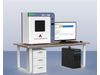
desktop XRD-2D xrd
The 2D-XRD is designed for industrial production and quality control. It is a functional and miniaturized desktop X-ray diffractometer. It is capable of accurately conducting qualitative, quantitative, and crystal structure analysis on both metallic and non-metallic samples. It is especially suitable for the manufacturing industries of catalysts, titanium dioxide, cement, pharmaceuticals, and other products. Contact sales engineer - Jane for detailed message Email: BOBLHH999@163.COM1. The photography mode is efficient and fast, about 5-30 times faster than the scanning mode,suitable for in-situ analysis, and collecting diffraction information from different angles at the same time; High energy resolution, effectively reducing fluorescence background;
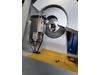
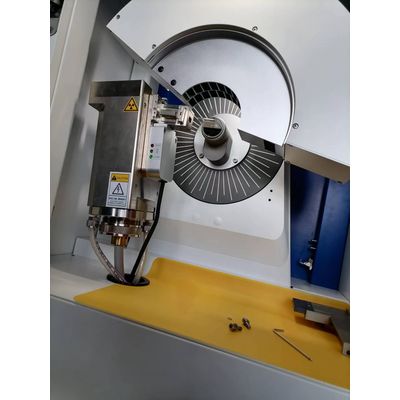
2. Goniometer、θs θd-arm adopts servo motor drive and optical coding control technology, and the detector can be driven along 2θ By moving the axis in two positions, the goniometer rotates more smoothly, the diffraction angle measurement is more accurate, and the linearity is better. Sample edge θ Axis rotation, control accuracy 0.01 °, 2 θ Axis angle accuracy ± 0.02 °;
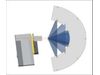
3. The AL-Y500 diffractometer is equipped with a detector assembly composed of multiple detector units, uniformly fixed along the diffraction circle, and seamlessly covering all angles; Simultaneously obtaining -3 °~150 ° 2 θ Angle range image, 2D imaging, and simultaneous collection γ Angle information.
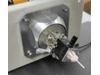
4. X-ray array photon counting semiconductor detector, highly sensitive, capable of single photon counting, large dynamic range, dual threshold, resistant to strong radiation and long-term exposure, with a long service life.
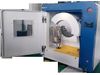
5. The radiation protection device is safer and more reliable. During sample measurement, the radiation protection door automatically prohibits opening, which can prevent operators from being exposed to scattered radiation under any circumstances. The compact size can be installed on the experimental bench without the need for a specific laboratory environment. Easy to use, operate and maintain.
The AL-Y500 diffractometer can be used for qualitative and quantitative analysis of polycrystalline materials. In qualitative analysis, instrument measurement data is compared with known-phase databases to identify unknown structures. In quantitative analysis, it is used to describe the characteristics of solid mixtures and determine the relative content of crystalline compounds or amorphous phases
Type Cu Target(target material can be selected)metal ceramic tube
Focus 0.4 × 10/1 × 10mm focus/ point and line can be interchanged
Max output 600W
Tube voltage 15~40kV ,1kV/Step
Tube current 5 ~15mA ,1mA/Step
Tube voltage and tube current stability ≤0.01%(Power supply voltage fluctuation 10%)
Angle measuring instrument structure θ/2θ
The structure of the goniometer Sample horizontal placed: θs-θd
Diffraction path geometry Bragg-Brentano / Debye-Scherrer , switchable
Goniometer radius 150mm
Scanning/radiography angle range -10~80° (θ) -3 ~150°( 2θ)
way of working Segmented/fixed radiography
θ Axis continuous scanning speed 0.125~30°/min
The minimum step-width angle 0.0001°
θ Maximum shaft speed 10°/s
2θ Angle repetition accuracy ≤±0.001°
Measurement accuracy ≤±0.02°
Types Curved single photon counting detector
pixel size 70 ×70μm2
Single frame area 20.1 ×20.1mm2
Noise <1cps
Energy resolution 380 eV
Quantity 11/21 pcs
Maximum linearity counting rate 3 × 10⁶ cps/pixel
Cabinet size( mm ) 770(L) × 520(W) ×800(H)
Weight(kg) 120
Dose of leakage of the scattering Lead, lead-glass protection, door-machine interlock, ≤0.2μSv/h
Security Interlock protect/power over load/ over heat
Ni filter Cu target
Overall stability of the entire machine ≤0.2%