


- Home
- Companies
- Durham Geo Slope Indicator (DGSI) - ...
- Products
- DGSI - Rod Extensometer
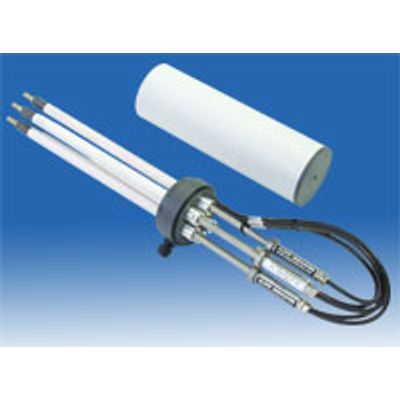
DGSI - Rod Extensometer
The Rod Extensometer consists of anchors set at specified depths, rods inside protective tubing, and a reference head. Measurements are taken at the reference head by micrometer or by an electric sensor. Advantages: Can be automated, can be read remotely, works in any orientation, can measure multiple points. Limitations: Limited measurement range (50 to 100 mm).
Components of a rod extensometer include anchors, rods with protective tubing, and a reference head. The anchors, with rods attached, are installed downhole. The rods span the distance between the anchors and the reference head, which is installed at the borehole collar. Measurements are obtained at the reference head with a sensor or a depth micrometer, either of which measures the distance between the top (near) end of the rod and a reference surface.
A change in this distance, found by comparing the current measurement to the initial measurement, indicates that movement has occurred. Movement may be referenced to a downhole anchor that is installed in stable ground or to the reference head, which can be surveyed. The resulting displacement data can be used to determine the zone, rate, and acceleration of movements, or to calculate strain.
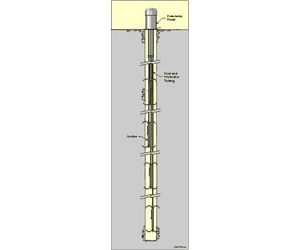
The rod extensometer can monitor up to six points along the borehole. The number of monitored points is limited by the size of the borehole, the type of anchor used, the diameter of the rods, and the amount of tubing required for grouting and activating anchors. A two-point extensometer typically requires a 60 mm (2.4 in) borehole; a four-point extensometer requires a 76 mm (3 in) borehole; and a six-point extensometer requires a 96 mm (3.8 in) borehole. Borehole size for packer anchors depends on number of anchors.
Two types of anchors are available: the groutable anchor is suitable for rock and the hydraulic anchor is suitable for soils.
Rods are made of fiberglass or stainless steel. Extensometers using 3/16-inch fiberglass rods can be pre-assembled at the factory, coiled, and shipped to the site, ready for installation. In general, fiberglass rods are easier to install in confined areas, such as tunnels. Fiberglass rods also resist corrosion and are preferred over stainless in alkaline environments. Extensometers using stainless rods must be assembled on site. Stainless rods are stiffer than fiberglass rods of the same diameter and are preferred when compression, rather than extension, is likely, or when longer lengths of rods are required. Protective tubing or protective pipe is installed with the rods to prevent bonding between the rods and grout.
Extensometer measurements can be obtained with a depth micrometer or a sensor. The depth micrometer is suitable when there is easy access to the reference head. However, when access to the reference head is difficult or where real-time or continuous monitoring is required, a sensor is the better option.
The rod extensometer monitors changes in the distance between one or more downhole anchors and a reference head at the borehole collar. Typical applications include:
- Monitoring settlement in foundations.
- Monitoring subsidence above tunnels and mines.
- Monitoring heave in excavations. Monitoring the stability of tunnels and other underground openings.
- Monitoring deformation in abutments and walls.