


- Home
- Companies
- Ocean Imaging Systems, A Division of EP ...
- Products
- OIS - Model 3731-D REMOTS - Digital ...
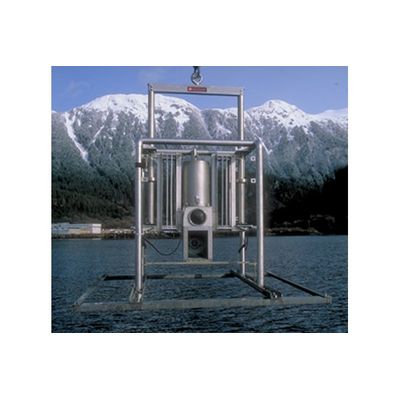
OIS - Model 3731-D REMOTS -Digital Sediment Profiling Camera
The Ocean Imaging System (OIS) Sediment Profiling Camera has evolved from the original Model 3731 sediment camera designed at Benthos in the early 1980’s with a 4000 meter depth rating. The original camera was developed in cooperation with Dr. Donald Rhoads and Dr. Joseph Germano who pioneered Sediment Profile Imaging (SPI) at Yale University.
The original Benthos design used a 35mm film SLR camera as its sensor, and OIS has re-designed various deployment frames and continuously upgraded the camera over the years. The current versions incorporate a 24.1 megapixel Nikon DSLR camera, providing high resolution digital images. The variety of designs for the Model 3731 camera include ones for diver operation, for handheld operation in shallow environments, and with a lightweight aluminum frame for small boat applications.
The Model 3731 is available in three housing materials (316 stainless steel, 17-4 stainless steel and 6061-T6 aluminum) rated for either 1,000 or 4,000 meter operation.
The Ocean Imaging Systems model 3731-D REMOTS (Remote Ecological Monitoring of The Seafloor) Digital Sediment Profile Imaging (SPI) camera provides in situ imaging of organism-sediment relationships on the seafloor.
Differing from conventional undersea photo equipment, the SPI obtains a vertical cross section of the sediment-water interface by imaging the sediment in profile via a water-filled prism. Its optical clarity is not affected by local water conditions since the optical path is through air and distilled water. High resolution images of an area as large as 320 cm2 of sediment profile are taken with each exposure.
The mechanical and electrical design of the 3731-D camera head has been based around ease of maintenance, access, and a simple, affordable upgrade path as new camera bodies become available. There are systems in use today which were originally built in the early 90’s.
The REMOTS Digital SPI was originally designed in 1984 in cooperation with Drs. Joseph Germano and Donald Rhoads who also developed the scientific methods for analyzing the resulting images. Updated to use an unmodified Nikon D7100 24.1 MPixel digital camera as a sensor, the REMOTS Digital SPI eliminates the need to process film either on-site or inthe-laboratory while retaining the proven instrument characteristics that have resulted in thousands of successful deployments around the world and yielded tens of thousands of images.
The REMOTS Digital SPI can be utilized to measure a wide variety of features, including:
- Grain size
- Small-scale surface boundary roughness
- Dredged material thickness
- Apparent redox potential discontinuity depth (aRPD)
- Subsurface methane gas pockets
- Surface microbial aggregations
- Infaunal successional stage
It has been used to detect changes in the benthos related to sewage or thermal plume discharge, and mapped habitat and sediment quality as well as anaerobic regions of the sea floor.
The combination of side-scan sonar and the Sediment Profiling Camera has proven effective as a rapid reconnaissance surveying technique when a client requires detailed information about large-scale topographic features.
- Camera CCD: 24.1 Mpixel CCD array (6,000 x 4,000 pixels)
- Optics: 35 mm Nikkor lens, (52.5 mm in 35 mm film equivalence), f/2 lens
- Viewing Area: 21.6 x 15.2 cm (8.5 x 6 in)
- Storage: Dual redundant 16 Gbyte SD Cards, stores approx 1000 high-resolution images
- Depth Rating: 1000 m (316 SS or 6061-T6 AL housing), 4000 m (Optional 17-4PH SS Housing)
- Materials: Standard: All stainless steel, except for lower frame which is galvanized steel with
- fiberglass mud doors. Optional: Aluminum prism & frame
- Flash Power: 6 watt-seconds
- Height: 168 cm (66 in) with prism up
- Length: 91 cm (36 in); 159 cm (62.5 in) with bottom frame
- Weight in Air: 236 kg (520 lbs) plus full weight set of 113 kg (250 lbs) (Stainless Steel Version)
- Width: 66 cm (26 in); 142 cm (56 in) with bottom frame
- Power: Internal 12-volt rechargeable SLA battery, 5.0 amp-hours.