


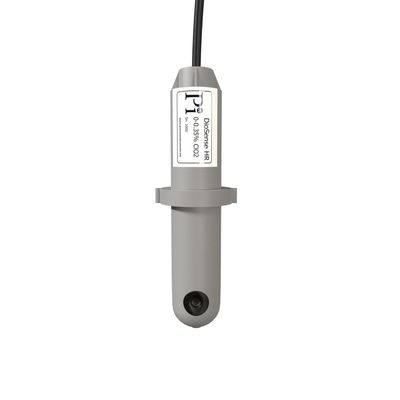
DioSense - Model HR -Online Chlorine Dioxide Sensors
How do you continuously measure high concentrations of Chlorine Dioxide solution online? Measuring a high level of ClO2 in solution is extremely difficult and has been traditionally done with expensive at-line optical instruments. The DioSense HR (0-3500 ppm) is an optical sensor measuring the absorbance of light at a particular frequency which is proportional to the amount of chlorine dioxide in the solution.
Why is it necessary to measure the chlorine dioxide content of water online and continuously? Chlorine dioxide generators often make chlorine dioxide solutions in several stages, starting with a high concentration and diluting to a lower concentration. Knowing the concentration of the higher concentration solution greatly improves the dilution process giving a much better controlled final ClO2 solution concentration.
The DioSense HR offers a number of benefits.
- Optical measurement meaning low maintenance and no reagents
- Integrated temperature compensation for stable results
- Simple pipe mounting for easy and inexpensive installation
- Fully integrated with the CRIUS®4.0 controller for easy process control and calibration
- Robust and suitable for harsh environments.
Chlorine Dioxide Generation – Modern chlorine dioxide generators can generate ClO2 in water at up to 3500 mg/L. This is then further diluted with water in order to reach a dosing concentration appropriate for the process. In order to do this, the starting concentration is often assumed giving often inconsistent results. Being able to monitor the concentrated ClO2 allows the operator to use a feed forward control to ensure the appropriate dilution, the result of which is much more consistent concentrations of the final chlorine dioxide concentration.
Chlorine dioxide (ClO2) absorbs light of a particular wavelength. DioSense HR uses this to measure the concentration of ClO2. Light of a particular wavelength is shone through the sample to a detector. The concentration of light that reaches the detector is inversely proportional to the concentration of ClO2 in the sample in accordance with Beer Lamberts law.