


Direct Air Capture (DAC) System
Direct Air Capture is a technology that captures carbon dioxide directly from the air with an engineered, mechanical system. Our Direct Air Capture (DAC) technology does this by pulling in atmospheric air, then through a series of chemical reactions, extracts the carbon dioxide (CO2) from it while returning the rest of the air to the environment. This is what plants and trees do every day as they photosynthesize, except Direct Air Capture technology does it much faster, with a smaller land footprint, and delivers the carbon dioxide in a pure, compressed form that can then be stored underground or reused.
Our Direct Air Capture technology has four major pieces of equipment that each have industrial precedent and have been widely used in large-scale industries for years. This is how our technology achieves megaton scale with low scale-up risk and improved cost estimations.
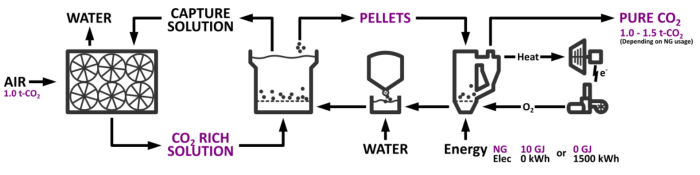
The process starts with an air contactor – a large structure modelled off industrial cooling towers. A giant fan pulls air into this structure, where it passes over thin plastic surfaces that have potassium hydroxide solution flowing over them. This non-toxic solution chemically binds with the CO2 molecules, removing them from the air and trapping them in the liquid solution as a carbonate salt.
The CO2 contained in this carbonate solution is then put through a series of chemical processes to increase its concentration, purify and compress it, so it can be delivered in gas form ready for use or storage. This involves separating the salt out from solution into small pellets in a structure called a pellet reactor, which was adapted from water treatment technology. These pellets are then heated in our third step, a calciner, in order to release the CO2 in pure gas form. The calciner is similar to equipment that’s used at very large scale in mining for ore processing. This step also leaves behind processed pellets that are hydrated in a slaker and recycled back into the system to reproduce the original capture chemical.
Megaton-scale
At CE, we`ve built our DAC technology by utilizing known equipment and processes from other large industries, and then innovating and integrating them to create our DAC system. This means our system can be built at large industrial scales with known supply chains and reliable equipment costs.
Affordable
At large scale, our DAC technology can capture C02 from the air for approximately US$100 per ton of CO;. For more information, please read our 2018 paper which provides a detailed process description and engineering cost estimate for a reference DAC plant that would capture one million tons of C02 per year.
Freedom of location
DAC plants are location-independent and so can be placed in locations where there is abundant, low cost local energy to power the facility, or where there is a high demand for CO2. DAC has the added advantage of being able to use non-arable land, and soourfacilities avoid competing for lands needed to grow food.
Closed chemical cycle
Our DAC technology captures CO- from the air in a closed "chemical loop" that re-uses the same capture chemicals over and over. This closed-loop chemical process is non-volatile, non-toxic and meets environmental health and safety standards, and it means we produce minimal waste products and require very minor supplies of chemicals to operate.
Flexible energy source
CE`s DAC process can take a flexible combination of renewable electricity and natural gas to power the system. When natural gas is used, the C02 from combustion is not released, but is captured and delivered along with the CO; captured from air. Our technology is also capable of reducing or completely eliminating the use of natural gas. instead relying on clean electricity as the sole energy source. This flexibility allows us to use natural gas. renewable electricity, or mixtures of both to achieve the lowest energy cost at each facility while also avoiding the creation of new emissions.
Emissions free
CE`s DAC plants do not create additional C02 emissions due to the way our engineers have integrated energy usage within the facility. Our technology is configured to capture the C02 from any natural gas used in powering the system. This means any emissions from natural gas usage are captured and delivered with the atmospheric C02 we captured from the air, and both streams are then used or buried permanently underground.