

OMT Solutions Bv
- Home
- Companies
- OMT Solutions Bv
- Products
- Directional Reflectance/Transmittance ...
Directional Reflectance/Transmittance Accessory for PerkinElmer Lambda Spectrophotometers
FromOMT Solutions Bv
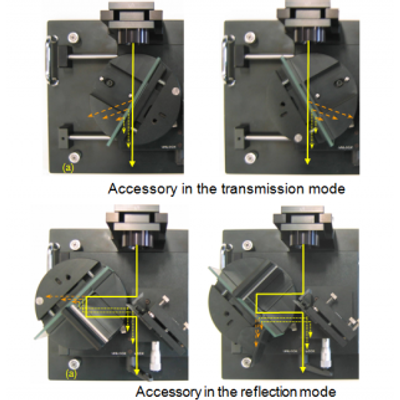
The directional reflectance/transmittance accessory provided by OMT Solutions is designed for PerkinElmer Lambda 750/950/1050 spectrophotometers. It enables both transmittance and relative reflectance measurements at normal and oblique incidences with a precision on par with metrology laboratories. The tool is intended for use with an integrating sphere detector and boasts distinctive measurement capabilities vital for accurate spectrophotometric analysis. This accessory, part number L6310201, is available through PerkinElmer. It supports high-precision measurements required for various applications, including the evaluation of solar energy properties in glazing and the analysis of angular dependent optical characteristics of low-e and solar control windows.Most popular related searches
color measurement
integrating sphere
spectrophotometer
spectroscopy monitoring
metrology
metrology system
spectroscopy
precision metrology
Our directional reflectance/transmittance accessory is the only commercially available accessory on the market offering the possibility of performing transmittance and relative reflectance measurements at (near) normal as well as oblique incidence, at an accuracy level comparable with that of metrology laboratories.
This accessory is intended for the PerkinElmer Lambda 750/950/1050 spectrophotometers and is used in combination with an integrating sphere detector.
- Absolute measurement of directional reflectance and transmittance of specular samples (Variable Angle Spectroscopy)
- Measurement of color shift as function of the angle of incidence
- Optical characterisation of coatings (e.g. coating thickness, optical constants of individual layers in multilayer Coatings)
- Measurement of both directional transmittance and directional reflectance
- Angles of incidence up to 85 degrees in transmittance and 75 degrees in reflectance
- Angular precision and accuracy of respectively 1’ and 5’
- Angular calibration through averaging over “positive” and “negative” angles
- Wavelength range of at least 250 – 2500 nm (limited by the range of the polariser)
- Separate measurements for p- and s-polarisation (GlanTompson polarizer included)