

Difloat - Dissolved Air Flotation (DAF)
Effective industrial and municipal wastewater treatment, clarification, and thickening technology. Napier-Reid’s DIFLOAT™ DAF systems are used for the removal of suspended solids (TSS), oils, fats and greases (OFG), algae and biochemical oxygen demand (BOD) from wastewater and other industrial process streams. DIFLOAT™ systems are frequently used to provide wastewater pretreatment, product recovery and thickening of biological solids in industries ranging from food processing, to pulp and paper, to petrochemicals.
Treatment Process
DAF is a physical process that operates on a simple design philosophy which, combined with optimum conditioning chemistry and properly designed equipment, provides an efficient mechanism for solids and FOG separation.
Coagulation and Flocculation Zones
Incoming raw water is pre-treated with a coagulant and flocculant in the rapid mixing and flocculation chamber. The use of chemicals such as alum, ferric chloride, and de-oiling polymers enhances the flotation process by forming composite particles or flocs.
Flotation Tank
The chemically treated raw water enters the flotation chamber where it’s mixed with the injected supersaturated water, also known as whitewater. The DAF pump recycles a percentage of the finally treated water and produces supersaturated water by mixing water and air at high pressure. A pressure-reducing valve reduces the pressure of recycled supersaturated flow to atmospheric pressure just before it enters the flotation tank. The sudden decrease in pressure releases micro bubbles of size 10 to 40 microns. The micro air bubbles adhere to the suspended composite particles, which then rise to the surface due to their reduced density.
Skimming and Sludge Collection
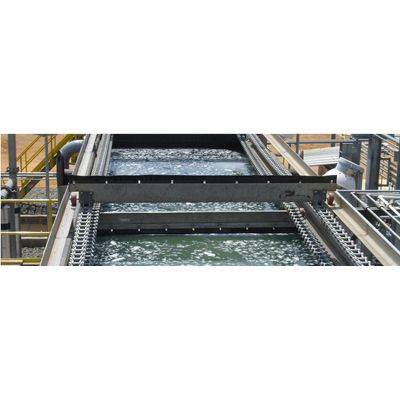
At the surface, a mechanical float removal device (skimmer) consisting of a full width scrapper with rubber blades travels over the tank surface and pushes the float over the beach plate into the scum collection channel. Heavier sludge settles in the bottom of the tank and a sludge draw-off pipe intermittently removes it. Selecting the correct frequency of scum removal mechanism and travel speed of the scrapper is important to get the desired solids content in the scum.
Collection
The clarified water reaches the end of the flotation tank which then flows under a baffle and into a collection trough, or is collected by submerged perforated pipe laterals. The clarified water then flows by gravity for further processing.
The DIFLOAT™ DAF system is one of the best engineered Dissolved Air Flotation systems on the market. Unique design features maximize sludge capture, reduce operating costs, and allow for easy maintenance.
- Recycle-Flow Pressurization. Which allows the system to operate at higher pressures and minimize the destruction of floc formed in the process flow, thereby increasing the effectiveness of the system.
- Improved Air Saturation System. DIFLOAT™ uses 50 to 70% less recycle flow than conventional DAF systems while introducing the same amount of dissolved air into the flotation tank.
- Efficient DAF Recycle Pump. Designed to operate at high pressures increasing the amount of saturated air by 46% more than traditional centrifugal pumps.
- Optimum use of coagulants and flocculants. Which promotes stronger floc formation, lower float volumes, and lower float moisture content, allowing the DIFLOAT™ system to operate with much lower air:solids ratio and higher solids loading rate.
- Compact Design. Due to its high loading rate, the area needed for a DIFLOAT™ system is approximately 15% of that required for a conventional clarification, utilizing the space more efficiently.
- Cost-effective. Our packaged DAF plants are pre-assembled and pre-tested in our controlled facility, often saving 50% or more over in-situ construction. They can also be integrated into pre-engineered building systems for increased savings and reduced schedule.