

Dissolved Gas Removal Membrane Systems
Non-porous perfluoropolymer membranes remove dissolved gases from liquid. Applications include unit operations (e.g., removal of dissolved oxygen in your fuel) or for sensing purposes (e.g., removal of gases from transformer oil to sense for degradation and wear on the transformer).
In both cases, the removal of gases can be done in real-time, streamlining the process.
CMS’s unique perfluoropolymer membranes are designed with very high gas permeance to allow for effective and timely removal of gases from liquids such as transformer oil, lubricating oil, fuels, process solvents, etc.
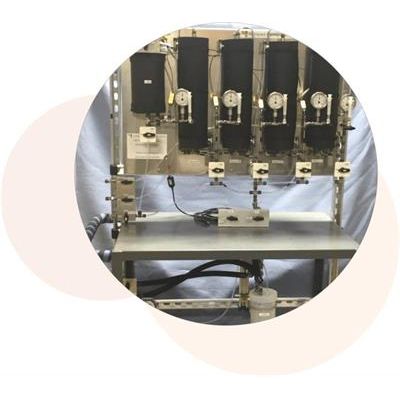
Very compact systems minimize the system footprint.
Degassing is useful unit operations and for sensing requirements. In sensing applications, the goal of the degassing or gas extraction is to remove sufficient gas to allow sensing of the gases’ particular makeup. This is used in mission-critical environments including:
- Power generation
- Power distribution
- Chemical detection
In the unit operations example, the degassing improves the ability of the liquid to perform its required task. This is important in:
- Fuels
- Solvent recycling
- Lubricating fluids
- Transformer oils
- Inkjet printing inks
- High Performance Liquid Chromatography (HPLC)
- Stable and long-lasting – products have been immersed continuously in transformer oil and performing gas extraction functions in those products for >15 years with no failures
- Highly permeable to gases – provides high flux of gases through the membrane to a sensor or for unit operation of gas removal. In either application, the high flux allows for a compact gas removal system
- Chemically and thermally stable – provides a wide range of operating conditions for gas extraction