


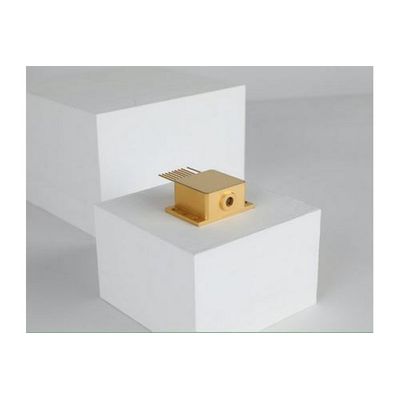
Unimir - Distributed feedback Quantum Cascade Lasers (QCLs)
Power and precision; Laser spectroscopy is a technique used to measure concentration of molecules in various applications like pollution monitoring, process control or non-invasive medical monitoring. Indeed, most molecules absorb infrared light at specific wavelengths and therefore, by tuning our infrared laser at the right wavelength and shining it on a given gas, liquid or solid sample, our clients can determine the amount of molecules present in the sample with the right detection setup (using pyroelectric detectors or photoacoustics for example).
One core parameter of successful laser spectroscopy is the selected wavelength and mirSense offers its clients the unprecedented 10 to 17 microns wavelength spectrum. The production of QCL lasers in the 10-17 microns range is unique in the world as mirSense holds an exclusive license of this technology developed at the University of Montpellier, France. In this long wave wavelength region, customers can detect various molecules like BTEX or hydrogen cyanide (see below some examples). Furthermore at these long wavelengths, the intrapulse linewidth broadening is relatively smaller than in the mid-infrared region and therefore, pulsed operation can be more attractive for spectroscopy.
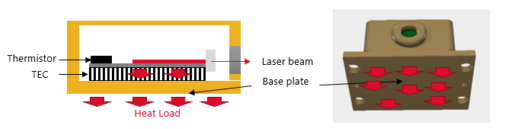
The uniMir lasers are mounted on a thermoelectric cooler (TEC) inside a sealed High Heat Load (HHL) package integrating a collimation lens and a thermistor to readout the laser chip temperature. By controlling the chip’s operating temperature through the TEC element inside the laser’s package, customers tune the emission wavelength without mode hopping while keeping a single-mode operation.
- Very tight linewidth that drives the very high sensitivity of gas sensing
- CW operation delivering mW levels of output power at room temperature
- Pulsed operation for larger tuning range is a good option because at these long wavelengths, the intrapulse linewidth broadening is relatively small
- Low power consumption for integration in portable gas analysers
- Very stable over time with good Allan deviation results when integrated inside a gas analyser