


- Home
- Companies
- Dormer Soil Samplers
- Products
- Dormer - Model SDRILL - Sandrill
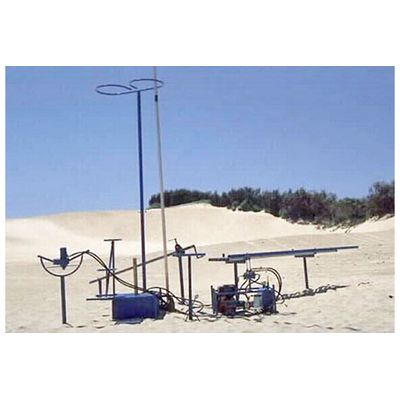
Dormer - Model SDRILL -Sandrill
This unit was designed in the 1950’s, specifically to sample minerals in deep sand deposits. However, more and more are being purchased to fulfil a variety of other tasks.
Some of these include, installing piezometers to monitor water tables; monitoring the stability of sludge dams; assaying old gold mine waste stockpiles in the Republic of South Africa; and sampling/testing the suitability of foundations for designs of major constructions in soft strata.
The Sandrill can test drill very sandy friable soils, take accurate samples and record depth to rock levels quickly, cheaply and without disturbing the ecology.
It is ideally suited for preliminary investigation work and is equally useful for ongoing assessment work.
It can be established on remote or difficult sites cheaply, without the need for other power sources or pumps. It can be transported by small commercial vehicle or helicopter or small boat or can be hand carried by the operators without dismantling.
It can be setup and operating in an hour and only needs a small clear level site for the operators to move around on.
-
Portability: The drill can be transported by plane, helicopter, boat or 1 tonne truck. It can be carried by 2 men, the heaviest component is 73kgs. No dismantling or reassembly is required. No access roads or clearing is required.
-
Simplicity: It can be setup in an hour and operated by unskilled personnel. A small, easy to read information booklet comes with the drill
-
Low Cost: Priced far below the hire rate of other conventional drilling rigs. Parts are readily available and most can be sourced at any hydraulic supplier. Very cheap to transport and setup on site. Very low running costs. No compressors, mud pumps or power sources required.
-
Drilling Rate: Up to 30 metres per hour can be achieved in increments of 1.5 metres. Can drill through layers of clay, indurated sand and limonite.
-
Drilling depth: Designed to reach depths of 100 metres in unconsolidated sand. Can drill through perched watertable (may require casing).
The Sandrill consists of 3 main components (Engine unit, Lifting Unit & Drive Head) plus the accessories plus the augers and extention rods.
-
Engine Unit: Is an 11hp Briggs & Stratton IC petrol engine coupled to a hydraulic pump and housed in a protective carry frame with fold away carry handles. The hydraulic reservoir, filter and controls are mounted on it.
-
Lifting Unit: Is connected to the Engine Unit by hoses with quick release couplings. The lifting unit raises and lowers the drill string by a system of hydraulic motors powering concave rubber drive wheels and is fitted with a hand brake.
-
Drive Head Unit: Is connected to the Engine unit by hoses fitted with quick release couplings and has a hydraulic motor driving through a gearbox which simultaneously turns the special counter rotating inner and outer auger system. There is little physical effort required and no “kickback” is experienced through the drive unit because of the balancing effect of the counter and rotating auger system.
-
Sandrill Accessories: These come with the sandrill as standard equipment and include: rod racks, rod mast, rod mat, Drive Head stand, bore protector, sample removal equipment, pipe vice on stand, hand auger (for setting up) and tools.
-
Sandrill Augers & Extention Rods:
-
The augers are 4.5 metres long, 45mm OD and have a special stainless steel spiral inside. The auger takes 1.5 linear metre samples from the 45mm diameter hole which takes about 30 seconds. The Drive Head is attached by a quick change bayonet type coupling.
-
The extention rods are aluminium with steel threads and come in 3.0 metre lengths with one 1.5 metre length to alternate. When drilling deep holes the drilling string is raised and broken into 6 or 9 metre sections which are stood in the mast (Christmas tree) provided.
-
One hundred metres can be raised in 12 minutes by an experienced crew. The auger is removed and while the sample is being emptied, another auger is fitted and lowered, to start the cycle over. The full cycle takes from 2 to 25 minutes depending on the depth and conditions.