

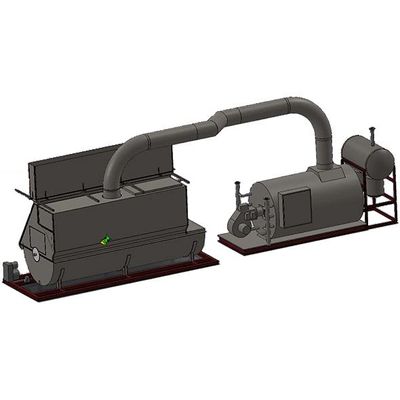
Draygon - Model LSS -Liquid Solid Separator
The LSS system was first designed for thermal desalination to extract fresh water from salt water, however after countless hours of testing and redesign we have developed a system that can far exceed beyond what it was originally designed for. We have developed a system that is able to go anywhere in the world in tis own self-contained unit and take any kind of aqueous waste stream including RO concentrate and turn it into useable drinking water.
Options include condensation of steam for reuse, and self-containment. The LSS system is capable of running on many different fuels, such as, but not limited to:
- Natural Gas
- Steam
- Oil
- Wind
- Solar
- Geothermal
- LPG
- Methane
- Multi-Fuel
- Waste Heat
- Waste Oil
Induction, thermal, electric, or any combination of the above heat sources is feasible. This provides many alternatives in countries that need to take contaminated water and concentrated waste streams and provide clean usable water and reusable soil fertilizer. We like to partner with people who share the same vision of helping those in need while preserving the environment.
- Methane
- Multi-fuel
- Waste heat
- Waste oil
Induction or any combination of these heat sources, thermo electric is a possibility. We feel that this would be best served in countries that need to take contaminated water and concentrated waste streams and provide clean drinking water and reusable energy. We can also be most useful in the process of landfill leachate for again we have the only self-contained portable unit that can run on any kind of fuel source and regenerate energy in the process. We would like to partner with people who share the same vision of helping those in need while preserving the environment.
The Draygon LSS system combines the advantages of several proven evaporation techniques and technologies developed to date, while similarly removing the drawbacks of prevailing equipment available on the market. For example, the wastewater is delivered into the upper chamber of the evaporator tank, from there it processes through falling film, static mixing, and direct immersion to promote “contact” evaporation. The atmosphere within the inner tank is indirectly heated via an oil heat or steam transfer jacket attached to this chamber. This effectively enables the entire volume and surface area of the inner tank to act as the chamber for evaporation. Radial (and variable speed) fans control the air exchange in the LSS, with the resultant updraft rapidly cooling the evaporate prior to exiting the unit as humidity. Since the heat is transferred via a heat transfer jacket, the whole system is classed as a “Run Dry” system, effectively achieving Zero Liquid Discharge (ZLD). Furthermore, during the initial atomization process, VOCs and Alkane chains are broken down into carbon and hydrogen. Hydrogen quickly reforms with oxygen molecules to produce additional water for evaporation, while carbon drops to the base of the tank for collection within the remaining residual solids.
The oil or steam surrounding the inner tank becomes a thermostatically controlled heat exchanger that allows solids to settle harmlessly on the tank floor; thus simplifying its removal. The unit’s oil bath typically operates at a maximum temperature of 650°F, with the evaporation process typically occurring below 200°F within the inner tank. This design encourages the accumulation of residual solid build up upon the base of the evaporator’s inner tank (where it is automatically removed), while providing a controlled evaporation rate and minimal maintenance issues, allowing easy continuous disposal of concentrate.
- Landfill Leachate
- Fracking
- Gray Water
- Black Water
- Wash Bays
- Nuclear Power Plants
- Airplane Wash Water
- High Volume Waste Water Generators