


- Home
- Companies
- DX Fluidics
- Products
- DX Fluidics - Droplet Microfluidic Chip ...
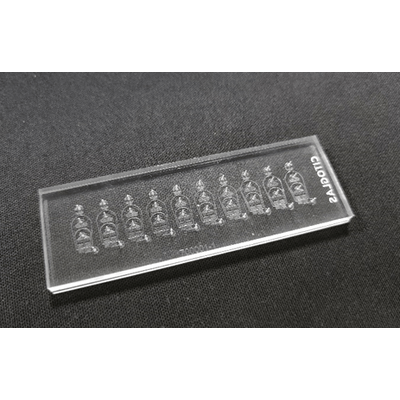
DX Fluidics - Droplet Microfluidic Chip for Laboratory and Clinical Applications
Droplet microfluidic chips represent a significant advancement in microfluidic technology by facilitating complex biological and chemical experiments through the precise control of droplets on a micron scale. Integrating microfluidics with chemical analysis and biology, these chips automate and miniaturize experiments, enhancing laboratory research and clinical diagnostics. The core technology involves the division of liquids into droplets within micron-sized channels, allowing for precise control over mixing, reactions, and separation of samples, reagents, or drugs within the chip. Their wide-ranging applications include biomedical research, chemical synthesis, diagnostics, and environmental monitoring. In biomedical research, they enable high-throughput assays like gene sequencing. In chemical synthesis, precise reaction control accelerates drug development. Microfluidic chips also improve biomarker detection in diagnostics and pollutant separation in environmental monitoring. Despite challenges in technical complexity and material compatibility, droplet chips offer high integration, automation, and cost-effectiveness, promising transformative impacts in science and medicine.
Droplet Microfluidics is a microfluidic technology that performs a variety of biological and chemical experiments by controlling and manipulating droplets on a micron scale.
The technology combines knowledge from a variety of fields, including microfluidics, chemical analysis, and biology, and has the advantages of being highly integrated, automated, high-throughput, and low-cost, providing new possibilities for laboratory research and clinical diagnosis.
In this article, we provide a detailed overview of the fundamentals, application areas, advantages and challenges of droplet chips.
1 Basic Principles of Droplet Microfluidic Chips
Droplet chip is an experimental platform based on microfluidic technology, the basic principle of which is to divide the liquid into tiny droplets through micron-sized pipes and control devices.
These droplets can contain samples, reagents, or drugs, and through precise control, the droplets flow within the chip to enable mixing, reaction, and separation between different liquids.
The basic principles of microfluidics are applied here, allowing for more precise and flexible experimental conditions and the ability to perform large-scale experiments efficiently.
2 Applications of Droplet Microfluidic Chips
Droplet microfluidic chips find wide-ranging applications in various fields, including but not limited to:
Biomedical Research: Used for cell cultures, DNA analysis, protein analysis, and more. The chips enable high-throughput experiments such as gene sequencing and cell sorting, accelerating disease research and drug development.
Chemical Synthesis: In organic synthesis, droplet chips achieve efficient and precise reaction control, expediting the synthesis of new drugs. Additionally, microfluidic chips are extensively used in catalysis research and catalyst screening.
Diagnostics and Detection: In medical diagnostics, droplet chips enable rapid and sensitive detection of biomarkers. Microfluidic technology allows simultaneous detection of multiple biomarkers, enhancing diagnostic efficiency.
Environmental Monitoring: Applied in monitoring water quality, air, and other environmental factors. Microfluidic chips effectively separate and detect pollutants in tiny droplets, improving the precision and speed of environmental monitoring.
3 Advantages of Microfluidic Droplet Chips
High Integration: Microfluidic droplet chips achieve multi-step experimental processes on a small chip, ensuring high integration and minimizing laboratory space requirements.
Automation: These chips utilize precise control and automation systems to reduce manual operations, enhancing experimental efficiency and reproducibility.
High Throughput: Through parallel operations and high integration, droplet chips achieve high-throughput experiments, significantly improving experimental efficiency.
Low Cost: Due to their small size, minimal material requirements, and increased automation, droplet chips offer relatively low experimental costs.
4 Challenges of Droplet Microfluidic Chips
Technical Complexity: Designing and manufacturing droplet chips involve knowledge from multiple fields, leading to high technical complexity that requires skilled professionals.
Standardization Issues: The lack of standardized manufacturing and operating methods in the field poses challenges, making it difficult to replicate and compare results across different laboratories.
Material Compatibility: Droplet chips demand materials with high compatibility at the micrometer scale, presenting challenges in ensuring material compatibility during manufacturing.
Conclusion
Droplet microfluidic chips, as a crucial application of microfluidic technology, hold vast application prospects and significant development potential. With continuous technological advancements and efforts toward standardization, droplet chips are poised to have profound impacts on life sciences, chemistry, medicine, and more, bringing forth innovation and possibilities in scientific research and medical diagnostics. However, addressing the challenges is essential to fully realize the potential of droplet microfluidic chips in serving scientific research and societal applications.