


Duranet
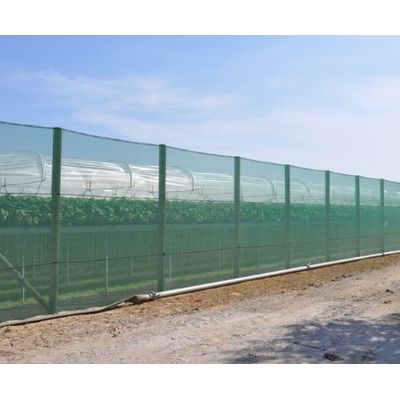
Duranet - Heavy-Duty UV Stabilised Polyethylene Windbreak Nets
FromDuranet
Heavy-duty, tear-resistant fine-mesh windbreak nets from Duranet are constructed from knitted UV stabilised polyethylene monofilament and include polyester eyelets woven in on both long sides and every metre in height. These nets are designed to protect plants, flowers, and shrubs against wind damage, prevent soil desiccation, reduce frost damage risk, and limit wild seed dispersal. Widely used in ornamental horticulture, they help prevent wind erosion in container fields and protect plastic tunnels during stormy weather. Additionally, these nets can be used horizontally as durable shade nets, providing versatile applications. Available in various wind reduction capacities, they cater to different requirements, ensuring robust protection for agricultural and horticultural needs.Most popular related searches
windbreak
fine mesh screen
wind erosion
windbreak fence
UV stabilized netting
tunnelling
erosion prevention
surface cleaning
Heavy-duty, tear-resistant fine-mesh windbreak nets made from knitted UV stabilised polyethylene monofilament, with polyester eyelets woven in on both long sides and every metre height.
Duranet windbreak nets protect plants, flowers and shrubs against the wind.
They prevent soil desiccation, reduce the chance of frost damage and limit the spread of wild seeds. In ornamental horticulture, the nets prevent wind erosion in container fields and prevent plastic tunnels from being blown away or damaged by the wind in stormy weather.
Windbreak nets are also suitable for horizontal applications as durable shade nets.
Mounting a windbreak net on wooden poles
- Installation of the poles:
- The poles need to be anchored firmly into the ground and preferably set into a concrete base (Ø 80cm and 1m deep)
- Interspace: maximum 3m
- Pole dimensions: Ø 8cm x 2m for a net height of 1m, Ø 10cm x 2.5m for a net height of 1.5m, Ø 12cm x 3m for a net height of 2m.
- Marks are affixed to the first and last pole near the polyester eyelets (every metre or every 1.5m) to indicate where the cables need to be attached.
- The net is completely rolled out on the ground and the tension cables are passed through the polyester eyelets. Ø 3 mm PVC-coated steel wire ropes or polyester cables are to be used as tension cables.
- The net is folded like a curtain. The various cables are attached to the first pole.
- The loose end of the upper cable is tensioned by means of a tackle and fixed to the last pole. This procedure is repeated for the other cables.
- The net is nailed to the first pole by means of a batten. Subsequently, the net is unfolded over the cables up to the next pole and nailed down. Etc.
- The net's eyelets are attached to the first and last pole by means of cable ties. The cable ties are placed around the pole, passed through the polyester eyelets closest to the pole and tightened.
- Finally, the upper and lower cable are nailed to all poles by means of staples.
Tensioning a windbreak net on a wire-mesh fence
- The net is completely unfolded on a clean surface.
- A Ø 4mm polyethylene rope is passed through the upper row of polyester eyelets. Identical ropes are passed through the middle (if present) and lower row of eyelets.
- The side of the net is turned around the first pole once and the three ropes are looped around the pole several times and tied.
- The net is tightened over the ropes. The end of the net is turned around the last pole. The upper rope is looped around the pole, tensioned and tied. The procedure is repeated for the middle and lower rope.
- At least once every 8 eyelets, the tension ropes are attached to the wire mesh as well as to each pole by means of black cable ties.